
Time management of Burj Khalifa: challenges and solutions of the megaproject

Introduction
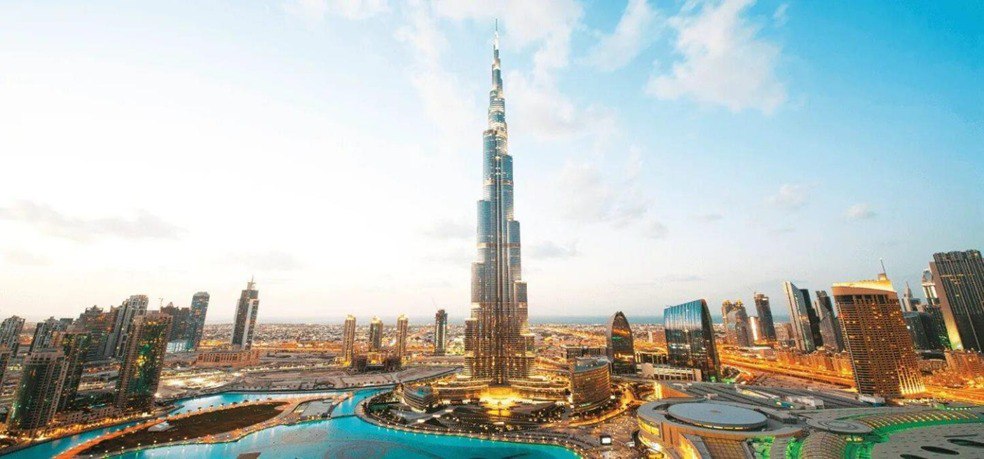
The construction of the Burj Khalifa, the tallest skyscraper in the world (828 m, 163 floors), was an unprecedented challenge in terms of project management. The giant megaproject in downtown Dubai took about six years to complete, with excavation work starting in January 2004 and the official opening in January 2010.
Initially, when planning, the construction time for the tower was 48 months. However, during the implementation of the megaproject, the team faced a number of difficult tasks. The technical novelty of the design, the multi-level structure of contractors, extreme weather conditions and even the global financial crisis - all this threatened to disrupt the schedule. However, the project team (client Emaar Properties, EPC contractor Samsung C&T in partnership with BESIX and Arabtec, and PMC contractor Turner International) managed to adapt and implement effective solutions to meet deadlines. Below, we look at key challenges in managing the Burj Khalifa construction schedule, the team's response, and lessons that may be useful for future megaprojects.
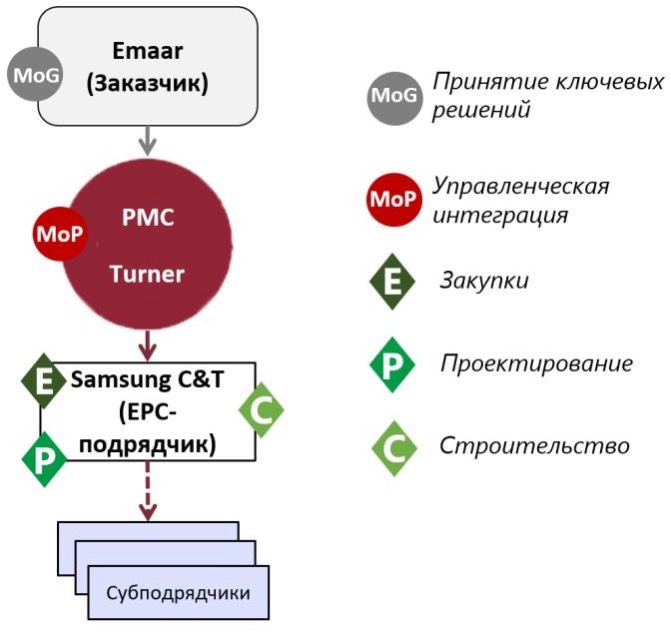
Burj Khalifa Construction Contract Scheme (EPC+PMC).
Key challenges and schedule deviations
Technical complexity and height of the building. Constructing the tallest building on the planet presented its own unique challenges. The megaproject initially assumed a very short timeframe - the construction 160 floors in 4 years required unprecedented speed of work.
To achieve this, the builders planned a three-day concreting cycle for each new floor. However, the complex architecture and engineering support of the tower prevented the implementation of such a pace. In addition, during the implementation of the megaproject, the height of the tower was increased (from ~808 to 828 m) and new elements were added, such as the luxurious Armani hotel inside. These changes in the project led to adjustments to drawings and recalculation of structures, which took additional time.
Thus, technical innovations and changes in design were the first factors that influenced the shift in construction schedules relative to those planned in the schedule network model.
Multi-level system of contractors. The general contractor was a consortium Samsung-BESIX-Arabtec, hundreds of subcontractors were working on site simultaneously-according to some estimates, more than 100 simultaneously.
Coordinating so many organizations-from steel and concrete suppliers to façade and MEP installers-presented a huge challenge for project managers. It was found that in the early stages, long documentation approval cycles (for example, review of project applications took up to 21 days) slowed down real progress. Difficulties were also caused by the need to coordinate schedule network models of different contractors: concrete workers, facade workers, elevator suppliers, etc. Without a unified schedule control system, gaps and overlaps easily arose. As a result, the beginning superstructure construction (aerial part of the tower) was delayed for about a year compared to the original plan - instead of the beginning of 2004, active construction began only in March 2005.
Logistics and scope of work. The project required enormous resources and their uninterrupted delivery. In total, about 22 million man hours with a peak workforce of more than 12,000 workers from 100+ countries.
Managing so many people and equipment in a limited urban area is a challenge in itself. In the midst of construction, daily logistics required careful planning: concrete, steel, double-glazed windows - everything had to arrive on time. Any failure, for example, a delay in a concrete mixer due to traffic jams, could disrupt the schedule for pouring the next floor.
Weather conditions and environment of Dubai. Climatic factors also influenced timing risks. Dubai is known for extreme heat in the summer - daytime temperatures on site reached +50 °C. In such conditions, working during the day in the open sun is unsafe and ineffective: workers are forced to take long breaks, equipment overheats, and concrete sets too quickly. In summer the main Concrete pouring was moved to night time. The process was specially cooled: part of the water in the mixture was replaced with ice so that the temperature of the concrete during laying did not exceed +28 °C.
These measures allowed construction to continue, but required rescheduling of work shifts and delivery of materials during the dark hours. Unforeseen downtime due to weather conditions was built into the schedule as a reserve, but still created stress.
Problems with financing. During construction (2007-2009), Dubai was affected by the global financial crisis. In 2009, the developer Emaar was short of funding, and the UAE government had to support the megaproject with an infusion of funds. Although construction has not stopped, the crisis has slowed down some deliveries and finishing work.
In total, construction continued ~6 years (72 months) instead of the 4-5 years planned during planning, but given the scale of changes and the crisis, this result is considered successful. How did the team manage to minimize delays and bring the megaproject to completion with relatively few deviations?
Project team response to deadline problems
Redevelopment and revision of the schedule network model. Faced with the first delays, the project team quickly revised the implementation strategy. Company Turner International identified work lying on critical path of the project. After which the schedule network model was revised. The cycle of constructing the reinforced concrete frame by floor remained consistent, and subsequent operations (façade, engineering systems) were partially planned in parallel with the frame. For example, the installation of façade glass panels began on the lower floors while the upper levels were still being completed - this saved months by avoiding the sequential (cascade) implementation of these stages.
Increasing resources. Contractors have increased the number of labor and technical resources in critical areas. Thus, Samsung C&T organized round-the-clock construction in several shifts. Massive concrete work was carried out at night (as mentioned, in the cool of the night, with the concrete chilled). During the day, work on reinforcement, installation of formwork and other preparatory operations proceeded in parallel. Increasing resources, of course, increased the cost, but Emaar was willing to invest to reduce the schedule gap.
Improving processes and communications. The key step was the optimization of internal megaproject management processes. Turner implemented a comprehensive project information management system during construction to track documents, bids, changes and decisions in real time. This made it possible to better coordinate the efforts of all participants: consultants, architects, contractors. Speeding up document flow has become especially important.
After analyzing the lags in the Prolog system, Turner managers discovered opportunities to reduce these deadlines. They implemented the rule 21 day cycle response to each application, and then, seeing that many problems could be solved faster, they reduced the period to 10 days for approval.
In addition, daily planning meetings were held between the main parties. Representatives Emaar (customer), Turner (PMC contractor), Samsung C&T (general contractor) met regularly to discuss the status of key milestones. Such tripartite control ensured a unified vision of the situation: if the contractor warned about a potential delay in a certain area, they jointly looked for a solution - for example, they attracted an additional team or switched resources from lower-priority work. Data Transparency was one of the success factors: Turner generated clear graphical reports on the status of the project, which showed progress on each node. This increased the responsibility of the participants: everyone saw the current lag or ahead of the plan, which motivated them to catch up.
We also jointly developed a risk management plan: for example, night shifts were included in planning for the hot season; in case of delay of materials, they had alternative suppliers or stock in the warehouse.
Phased and control of key stages. The project was divided into clear phases: preparation of the site and foundation, construction of the above-ground frame, installation of the facade, interior finishing and commissioning. The transition to each next stage was carried out only after the formal completion of the previous one and a readiness check (passing the checkpoint). This approach prevented a situation where, for example, finishing begins before the building's contour is completely closed, which could lead to rework due to leaks or dust. Instead, although some work was combined, a logical sequence was followed: first, a stable foundation of 192 piles, 50 m deep, was completed (January-September 2004)
Then the go-ahead was given for the massive construction of floors (2005-2008). Once the frame reached the top in early 2009, the focus shifted to quickly closing the facade and running the elevators, without which the skyscraper could not open to visitors. Thus, the discipline of completing stages helped control key schedule milestones.
Schedule Management Tools and Techniques
Software tools (Primavera P6, MSP). Primavera P6 made it possible to calculate the critical path and automatically recalculate dates when connections or duration of work change, which is extremely important when there are frequent changes in the project. The Burj Khalifa construction schedule contained tens of thousands
tasks - from large (filling the next floor) to small (installing lamps on the level). The tool made it possible to assign a responsible contractor and the necessary resources for each task, as well as take into account restrictions (for example, you cannot begin installing elevators before the mines are ready).
BIM modeling and 4D planning. The project used elements of BIM (building information modeling), an advanced technology at that time. Although BIM was still gaining popularity in the mid-2000s, digital 3D models of individual systems (e.g. façade, utilities) were created for the Burj Khalifa. With their help, the network schedule was linked to the model - the so-called 4D modeling, when installation dates were tied to the elements of the model. This made it possible to virtually work through the process of performing a chain of work and identify potential conflicts in time and space. For example, the BIM model helped to detect the intersection of schedules: a team installing ventilation pipes could interfere with finishing work in progress in the same rooms at the same time. By modeling this, managers timed tasks to avoid future delays. In addition, BIM simplified the planning of logistics inside the building: the digital model showed how to deliver long elements to the upper floors through elevator shafts, which was taken into account in the schedule (time windows were included for lifting large parts before the installation of elevators). In addition, BIM served as a tool for volume control: using the model it was possible to accuratelythe quantity of materials was calculated, and deliveries were carried out "just in time", without shortages (which would lead to downtime) and excesses (which would lead to clutter and slowdown of work).
Execution control and daily monitoring. If schedule network planning is half the success, then the second half when managing deadlines is strict control of execution. The Burj Khalifa implemented a strict discipline of daily progress recording. Every day, foremen and engineers reported on the volumes completed (how many cubic meters of concrete were laid, how many columns were installed, etc.). Turner compiled this data into comparative tables with the plan. At the slightest underfulfillment, we immediately analyzed the reason: for example, they poured 5% less concrete due to a pump failure - they solved the problem (pump replacement, repairs) and, if necessary, adjusted tomorrow's plan to make up for lost time. This "plan-to-fact every day" approach allowed us to maintain high productivity.
If a contractor began to fall behind, he was given additional attention - people could be redistributed from neighboring sites or asked to work an additional shift on weekends. A motivation system for meeting deadlines was also introduced: bonuses for early completion of a section and fines for missing deadlines set during planning without a good reason.
The most important tool for monitoring deadlines was weekly meetings using a schedule network model with the participation of the customer. They showed a summary status: which works are in the green zone (according to plan), which are in the yellow zone (there is a risk of falling behind), and which are in the red zone (already falling behind). For the latter, an acceleration plan was immediately approved - attracting resources, working seven days a week, or revising the sequence.
Role of the PMC contractor
Important note the role of the PMC contractor. Turner International managed conflicts before they became delays and maintained a collaborative environment. Exactly
Thanks to the PMC contractor, modern project management technologies (Primavera P6, BIM modeling and 4D planning) were introduced and effective communication was established. Turner has done a great job of compiling, updating and optimizing the schedule network model of the megaproject. Thoughtful planning helped minimize backlogs. The PMC contractor combined following classical project management practices with non-standard, unique solutions in planning and communication. The competent work of a professional PMC contractor made it possible to build the tallest tower in the world in 6 years in conditions of an economic crisis, extreme heat and the incredible technical complexity of the project.
List of sources used
- Brief on the construction planning of the Burj Dubai Project. Dubai, UAE / Ahmad Abderazaq / 2008. URL: global.ctbuh.org
- Construction Management Case Study on Burj Khalifa / Vaibhav Shrivastava / 2015. URL: slideshare.net
- Iconic construction projects Burj Khalifa / Go Constract URL: goconstruct.org