
Managing the Channel Tunnel Project Timeline: Challenges and Lessons
19.08.2025

Channel Tunnel (Eurotunnel) - one of the most ambitious infrastructure projects of the 20th century, connecting Great Britain and France with a 50-kilometer underwater railway. The implementation of this megaproject faced serious time management challenges: the original schedule had to be revised, significant delays occurred in key milestones, and the final commissioning occurred approximately a year later than planned. This analytical article examines the original and actual schedule network models (CNM) of tunnel construction, quantitative indicators of deviations, planning and control methods that were used (and why some of them were ineffective).
Initial project plan and actual schedule: key milestones and timelines
The idea of a Channel Tunnel has a long history, but the modern project began in 1986 with the signing of the Franco-British Treaty (Treaty of Canterbury) and the granting of a concession to the private company Eurotunnel. The original schedule called for about 7 years of construction, with the tunnel scheduled to open to train traffic by May 1993. Key planned milestones included: commencement of work in 1987-1988, construction of three parallel tunnels (two main railway and one service) with back-to-back tunnels, connection of tunnels under the strait, provision of the tunnel with tracks, power supply, signaling, testing and commissioning.
The actual implementation of the main stages of the project was as follows:
- Start of tunneling: Construction officially began at the end of 1987, when tunnel boring machines (TBMs) began operating on the British and French sides. Active work on tunneling started in 1988.
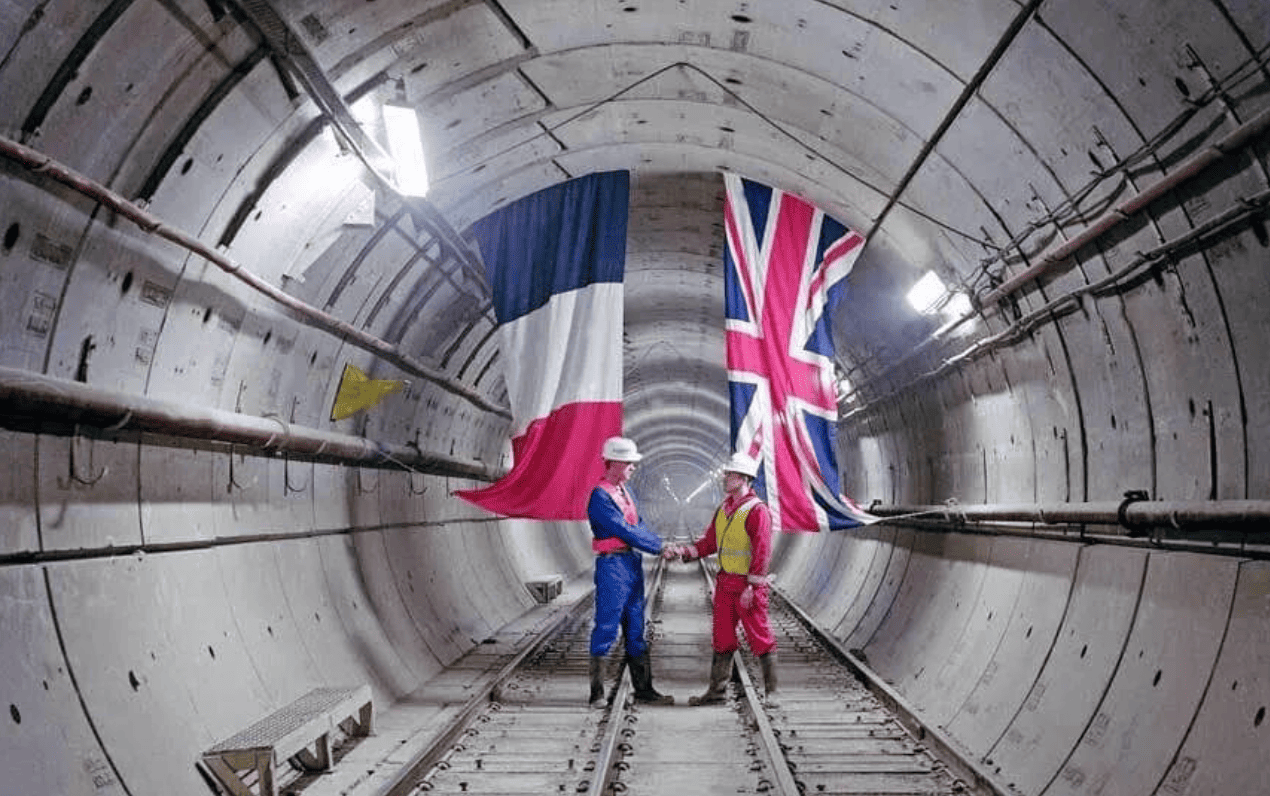
- Drilling a service tunnel: Already by December 1, 1990, a British and French TBM, laying a small service tunnel (for ventilation and evacuation), met exactly under the middle of the strait - this breakthrough was broadcast live on television. It is noteworthy that the service tunnel was completed exactly according to the original schedule - December 1990 coincided with the plan.
- Digging of the main tunnels: In May and June 1991, the two main railway tunnels were connected - several weeks ahead of schedule. Thus, the tunneling work was completed even faster than planned - estimated to be approximately 3 months earlier than expected. This is an outstanding achievement in the field of construction management: thanks to the efficient organization, 11 tunnel boring machines simultaneously excavated 12 faces on both sides, reducing the critical path through the excavation phase.
- Equipment and commissioning: Once the tunnels were completed, the focus shifted to the installation of tracks, power supply systems, signaling, as well as the manufacture and supply of rolling stock (special shuttle trains for cars and regular high-speed Eurostar trains). It was at this stage that the greatest difficulties with deadlines arose. Although the construction part (tunnels) was on schedule, the delivery of equipment and trains was delayed, which led to a shift in the overall opening date by more than a year. Thus, due to delays in the delivery and commissioning of rolling stock, the start of operation had to be postponed.
- Opening of the tunnel: The official opening of the English Channel Tunnel did not take place until May 6, 1994, at a ceremony attended by Queen Elizabeth II and French President François Mitterrand - that is, almost exactly one year later than originally planned. Freight services (shuttles for transporting cars and vans) started in June 1994 with limited capacity, and regular Eurostar passenger trains began operating only towards the end of 1994 (the first commercial London-Paris service took place in November 1994).
Thus, with a total construction duration of 6-7 years (from 1988 to 1994), the delay in the actual completion of the project was 12-19 months relative to the original schedule. According to official data, the Channel Tunnel project was completed a year later than planned. Some estimates indicate a lag of up to 19 months - this figure includes the full rollout of passenger services.
The analysis shows that failures to meet Eurotunnel deadlines were due to a combination of technical, organizational, managerial, financial and political-regulatory reasons.
For clarity, you can compare the plan and the fact by key stages:
- Tunneling: plan - until the end of 1991; fact - completed by mid-1991 (~3 months ahead).
- Minstallation of equipment, supply of trains: plan - 1992; fact - delays until mid-1994 (lag ~≈1-1.5 years)
- Tunnel opening: plan - May 1993; fact - May 1994 (delay ~12 months).
Applied methods of planning and time control
The schedule of such a megaproject was managed using traditional project management approaches, but not all methods worked effectively in the unique conditions of Eurotunnel. Let's look at what planning and schedule control tools were used and where problems arose:
- Decomposition and network planning. During the planning stage, a detailed baseline schedule was developed covering thousands of tasks on both sides of the strait. The project team divided the project into stages and works (WBS) and sequenced these works. The schedule took into account parallel processes: thus, simultaneous excavation was carried out from 12 faces (6 from the coast of England, 6 from the coast of France) using 11 tunnel boring complexes. For such a complex scheme, the critical path was calculated - first it went through the tunneling operations (because without through tunnels it was impossible to start laying tracks). As a result, the prepared basic plan turned out to be quite realistic for construction work: as noted earlier, tunneling was completed almost on schedule. However, the critical path of the project shifted to an unforeseen area - to the stage of equipment supply and approvals. The approach to planning itself was classic: a network diagram, determining dependencies, key milestones, calculating the time reserve (float), etc. We can say that the planning "on paper" looked adequate - the problems were rather in the assumptions and initial data.
- Milestone control (milestone control). The project had several publicly announced milestones, the achievement of which was monitored by all stakeholders. For example, the joining of tunnels in 1990-1991. - an important milestone that was successfully achieved on time. The project management implemented regular monitoring of progress: deviations were monitored monthly, and a detailed report was issued quarterly to a consortium of banks and shareholders. It can be said that the reporting and control system was strict - senior management and investors kept the project under close supervision. To some extent, this helped contain further deterioration: for example, despite numerous problems, the tunnel opened "only" a year later, and not several years, thanks to constant pressure from regulatory authorities and creditors. On the other hand, overload with reporting and multi-level coordination of decisions slowed down operational management.
- Fast tracking - parallel execution of phases. One of the methods that Eurotunnel has deliberately used to reduce schedules is to overlap the design and construction phases. Typically, detailed design is completed first, then construction begins. Here, in order to gain time, some of the detailed developments were carried out in parallel with construction work. For example, tunnels were still being built, and engineering systems (ventilation, cooling, fire-fighting infrastructure) were designed on the fly. Moreover, production of rolling stock began before all tunnel testing was completed. Such fast-tracking really allowed us to avoid additional delays - the construction part did not stand idle waiting for final drawings. As a result, despite extensive design changes, the builders managed to stay close to the original construction schedule - which is described as an "amazing achievement". However, the price for saving time turned out to be high: parallel execution of phases led to a huge amount of processing (abortive work) and doubled the final cost of the project. In fact, the fast tracking method saved the schedule (the tunnel opened only a year later instead of potentially several years late), but became one of the reasons for the exceedancebudget\and financial difficulties of Eurotunnel. Also, the parallelism of work complicated change management - changes came when the construction of this part was already underway, which is why they remade the finished one.
- Change control & risk management. A key part of schedule management on megaprojects is change control and schedule risk analysis. In the case of the Channel Tunnel, as can be seen after the fact, the change control system failed: the IGC effectively had the power to demand changes on the fly, and the process of assessing the impact of these changes on the schedule was stalled. It was not clearly defined who was responsible for the consequences of the changes - as a result, no one bore formal responsibility for the delays associated with the new requirements (except for the financial losses of investors). The analysis of risks, especially non-technical ones, was incomplete. The risks of the process and approvals were underestimated. It was not calculated in advance how long bureaucratic approvals, checks of compliance with the standards of the two countries, obtaining certificates for trains, etc. might take. Eurotunnel management admits that the focus was on the engineering side of the project, and the risks regulatory and management delays were not properly taken into account.
In general, Eurotunnel's deadline control methods combined classic project planning (CPM networks, milestone control, reporting) with unusual solutions (fast track, splitting the team into national parts). Some of these steps helped achieve partial success (for example, passing the tunnel without being late), but collectively the system failed at the final stage.
In conclusion, time management in megaprojects is the art of balancing rigid planning with the necessary flexibility. The Eurotunnel project taught a hard lesson that underestimating complexity and being too hasty at the start can lead to delays and cost overruns later. However, well-implemented methods (a clear critical path for construction work, tracking progress, dividing the project into parallel streams) made it possible to minimize the backlog - the tunnel opened a year later, which does not look like a disaster for such a huge undertaking.
Sources:
- PMI - Project Management Institute, case study "The Chunnel Project" (analysis of the Channel Tunnel project).
- HFW (Holman Fenwick Willan), article "The Channel Tunnel: Have we learned our lessons?" (2014) - analysis of tunnel problems.
- The Guardian, "The boring details" - a timeline of Eurotunnel construction and finances theguardian.comtheguardian.com.
- Global Infrastructure Hub, "The Channel Tunnel" - megaproject review (2020), data on cost overruns and delays.
- Others: analytical article by H. Chen "Success of the Channel Tunnel Project" (2019); Institution of Civil Engineers (ICE) materials ice.org.uk; internal reports of Eurotunnel, etc. All of them confirm the stated facts and conclusions.