
- Home
- News
- Articles
- All Articles
- Foreign experience in project management
Application of the critical chain method in construction projects: conceptual analysis and practical implications



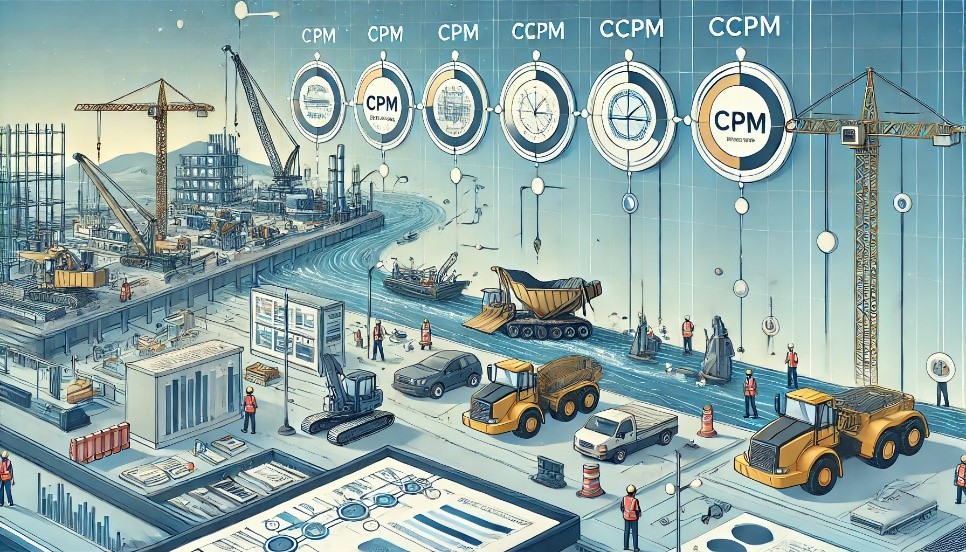
How to speed up the completion of complex construction projects? Analytical service PM Excellence prepared a review of research by Polish scientist Krystyna Araszkiewicz, analyzing how the critical chain method (CCPM) helps to handle projects faster and more efficiently than the traditional critical path method (CPM). Using the example of scheduling and network planning for the construction of a network of marinas in North-West Poland, it shows how thoughtful management of time and resources can significantly reduce deadlines and improve coordination of all participants.
Key challenges of project management in a multi-project environment
The critical chain method differs from the critical path method in that it focuses not only on the timing of tasks, but also on optimizing the use of limited resources, making it especially useful in project portfolio management.
For companies in the construction industry, a multi-project environment inevitably involves a number of key issues:
1. How are current projects aligned with the organization's long-term strategy?
2. Are project costs reasonable and justifiable in terms of strategic goals?
3. Does the organization have the resources to successfully complete all projects?
These challenges require the integration of schedule network modeling and resource management approaches to ensure coordinated project execution. This approach becomes the basis for the application of the critical chain multiple project management (CCPM) method.
Research methodology and comparative analysis of CCPM and CPM
The practical part of the study begins with a thorough study of the original contracts and network schedules for the construction of yacht marinas. A classic CPM approach was used to create the baseline plans. Then, using the CCPM method, the schedules were redesigned to find and minimize delays caused by critical resources. One of the key steps was to identify dredging equipment as a major bottleneck.
Further, temporary buffers were added to accommodate seasonal constraints such as waterfowl breeding. Projects were distributed over time so that critical resources were used as efficiently as possible. This flexible and thoughtful approach allowed not only to optimize timelines, but also to improve interaction between all program participants.
To evaluate the benefits of the critical chain method, the study combines analysis of contract documentation and a comparative approach to managing schedule network models. Key steps to apply CCPM:
1. Establishing project priorities in accordance with long-term goals.
2. Creation of schedule network models taking into account the limitations of critical resources.
3. Introduction of buffers to increase the reliability of deadlines.
4. Optimize the sequence of tasks to minimize downtime.
5. Distribution of projects over time according to given priorities with minimal delays in the operation of the critical resource, which sets the pace of implementation
This allows you to increase the efficiency of scheduling and network planning, especially when managing a portfolio of projects where resources are limited.
Analysis results and achievements
|
Project |
Duration of CPM (days) |
Duration of CCPM (days) |
Buffer size (days) |
|
Project 1 |
181 |
117 |
39 |
|
Project 2 |
100 |
88.5 |
29 |
|
Project 3 |
496 |
413 |
135 |
|
Project 4 |
320 |
240 |
80 |
|
Project 5 |
327 |
256 |
85.5 |
|
Project 6 |
375 |
279 |
93 |
|
Project 7 |
310 |
232.5 |
77.5 |
|
Project 8 |
102 |
75 |
26 |
|
Project 9 |
275 |
208.5 |
69.5 |
|
Project 10 |
240 |
172 |
58 |
The use of the critical chain method led to a significant reduction in the duration of the construction program from 794 to 586 days - a time saving of 26%. The comparison table below clearly demonstrates the differences:
Project Duration CPM (days) Duration CCPM (days) Buffer Size (days) Project 1 181 117 39 Project 2 100 88.5 29 Project 3 496 413 135 Project 4 320 240 80 Project 5 327 256 85.5 Project 6 375 279 93 Project 7 310 232.5 77.5 Project 8 102 75 26 Project 9 275 208.5 69.5 Project 10 240 172 58
The timeframe was reduced due to several important factors. First, equipment such as dredging equipment was well allocated to optimize key tasks. Secondly, time buffers were added to the schedule network schedules, which protected the deadlines for completing tasks from possible delays. Finally, special attention was paid to coordinating the work of all participants, which ensured the synchronization of processes and eliminated downtime.
Advantages of the critical chain method in construction programs
CCPM provides a systematic approach that helps to effectively manage projects and especially the project portfolio. Key benefits include:
• Transparency - you always know what to do first. • Reduced time - projects are completed faster. • Flexibility - the plan can be adapted to changes.
The marina example shows how the critical chain can minimize the impact of resource and time constraints, significantly reducing deadlines.
Application of the critical path method in planning construction projects in a multi-project environment: a case study. Kristina Arashkevich. West Pomeranian University of Technology Szczecin, Faculty of Civil Engineering and Architecture, Piastow Avenue 30, 70-311 Szczecin, Poland. Journal: Procedia Engineering 182 (2017) 33 - 41