
Assessing status "on balance" when managing large-scale projects - how bosses accustom themselves to lying


Repeatedly in large-scale projects, we have seen project managers and other responsible persons report to management at various levels in large percentages or large aggregated indicators. Often such a report lasts only a few minutes, and phrases such as:
- - installation work completed 87.26%
- - 1400 out of 1500 items purchased
- - the object is 95% ready, minor work remains
- - etc.
It is not always the case that during such reports, big bosses ask clarifying questions (especially if the stated percentage of readiness for something is above 80). In personal conversations with managers, I hear that with such stated percentages of readiness, there is a feeling that everything is going fine and no intervention is required.
But often behind these cheerful reports and aggregated percentages, serious delays in project deadlines are hidden. It is in unfinished remains that complex, time-consuming work that requires great effort and competence is hidden, which in gross terms is relatively small (for example, small but expensive equipment that needs to be installed in an inconvenient place on the site). The picture is aggravated by the fact that the report usually takes place without demonstrating the schedule network model of the project. Accordingly, there is no way to quickly clarify the announced indicators, their impact on other parameters, prospects, etc.
I have seen many times how the high level of readiness that is announced does not change for several months. It can be "funny" to watch how, from meeting to meeting, "90% completion" is reported for some type of work - and no one has any questions about why the overall value does not change, what the planned values are, or whether the fact that work is not being completed affects other indicators. Apparently, the demonstrated high percentage time after time reassures the management and other meeting participants...
During such meetings, reports are placed on the table of managers, examples of excerpts from which are presented below:
1) Document signing status
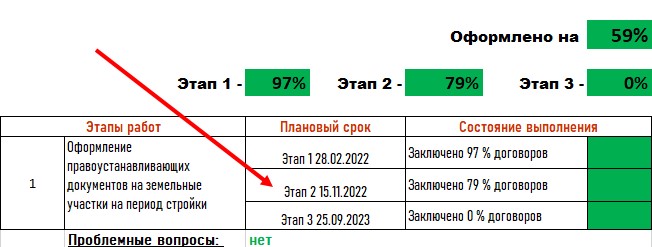
79% of contracts were concluded as of a long past date. Status - green. There are no problematic issues. It is impossible to draw a conclusion about the real situation.
2) Purchase of equipment and materials

In fact, the indicators seem to be high - but what should it be in accordance with the schedule network model? Is there something long-term, large-scale in the remaining percentage? It's impossible to understand.
3) Dynamics of construction and installation work
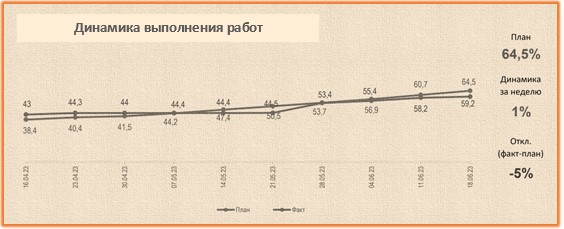
Weekly dynamics of 1% - is it good or bad? What should it be to achieve the planned rates?
Deviation 5% - what to do with this information? What work should be expedited? How will such a presentation of information help the manager make the right decision?
In order to evaluate the real picture on the project, it is not enough to state a fact (even if this fact is "beautiful"). Let's list what a manager needs to obtain to correctly assess the situation:
1) Comparison of the actual indicator with the planned one
The stated percentage of project completion can be high - for example, 90%. However, if according to the plan the readiness was supposed to be 95%, optimism immediately fades, because There is a lag behind the project implementation schedule.
2) Formulation of forecast indicators
Even if, when comparing actual indicators with planned ones, we saw a serious lag, forecast indicators can be quite acceptable (if, for example, the lagging tasks do not lie on the critical path in the schedule network model of the project - and then it will be necessary to take control of the task, tracking the pace of its execution).
And vice versa, there may not be a lag, there may even be an advance, but the forecast (built taking into account the current pace of work) may show that in the near future the task will be disrupted, and it is necessary to take measures.
3) Prioritization based on the amount of free reserve
We regularly observe how, in the event of missed deadlines, project teams try to "put out all the fires" at once, while declaring that supposedly "all this work is very important, critical." At the same time, critical work is often understood not as work that lies on the critical or near-critical path in the schedule network model, but as that which seems very important to a particular expert only on the basis of his internal feelings. As a result, attention is scattered over a wide range of work (including work that does not require attention at the moment). If there is a correct schedule network model, the planner can always rank jobs according to the amount of free reserve, thereby determining which jobs really need to be focused on.
If the manager receives information about the plan, fact, forecast, priorities in the report and report, and if it is possible to use schedule network modeling tools for analysis based on the "what if?..." principle, then the manager's chances of making timely and correct decisions are significantly increased.
The desire to reassure management with beautiful numbers is understandable. In addition, sometimes the bosses themselves build a system in which voicing an unpleasant truth can be fraught with danger for the speaker. However, if we are talking about projects in the success of which their main participants (investors, management, project team, future users) are really interested, then the requirement of honesty and transparency of reporting indicators is mandatory. The above components (plan, fact, forecast, priority) should become an integral part of reports on the status of projects and a mandatory requirement of managers at all levels.