
Not enough helmets! - What to do?



Author of the article Alexander Kochetov, PME and Bogdan Gorfinyak, PME, PMSE
The problem of inefficient use of available resources is common in large-scale projects and megaprojects. It arises in a situation where there are enough resources, and it gets worse when resources are very limited and it is necessary to correctly prioritize their use. "There aren't enough helmets!" - very frequent words of responsible executors who make excuses for missing deadlines. In such situations, we see examples of assault, when teams and equipment are distributed chaotically, obeying the momentary opinion of some "noisy" leader, who is capable of shouting down the rest of the participants at a specific meeting and convincing them of the priority of a certain task. It is almost impossible to double-check such an opinion (confirm it or refute it) in the absence of a correct schedule network model, as well as a system for collecting data from the site.
A similar situation arose at one megaproject, where our team was invited to help reduce deadlines. Arriving at the project, we saw a common (unfortunately) picture - there was no consolidated integrated schedule network model, each functional area had its own understanding of the current priority, the project team worked in emergency mode, putting out numerous fires (without really knowing what to pay attention to first).
We, together with the customer's planners, immediately began developing a detailed schedule network model, as well as approving it (through the order of the General Director) as a single information space for project participants. Within a month and a half, we developed a model that allowed us to carry out promotion of critical paths - thereby determining the focus on the priority tasks of the megaproject (based on the value of the full reserve). It is important to note that in addition to the model itself, a regulatory framework was developed for updating it, entering factual data into it and generating reports - it was important to clearly formulate and record the "rules of the game" for all participants in these processes.
The first promotion of critical paths showed us that the priority is to speed up work on the supply of equipment and materials. Seeing this, our team, together with the customer's employees, developed measures to speed up critical deliveries, which resulted in providing the construction crews with the necessary materials. However, during subsequent promotions, construction and installation work began to become a top priority - it became clear that in order to speed up this work, it was necessary to increase the number of teams carrying out the work or increase the pace of work by existing teams. And the general contractor had serious problems with this. The number of his own teams and the resources of subcontractors was absolutely not enough for all priority work.
It was clear that the general contractor would not be able to quickly increase resources to the required amount (even taking into account the fact that all subsidiaries of the company implementing the megaproject were "cryed out" for the need for help from the relevant specialists). Some representatives of the project management suggested replacing the general contractor - but after analyzing the situation, it became clear that it was too late to take such a radical step (the project is more than 75% complete, and any replacement at this stage is guaranteed to extend the project timeline (demobilization, concluding new contracts through competitive procedures, inventory, etc.)). The team was faced with a question: how to reduce the project implementation time in such a difficult situation?
After a series of discussions and elaboration of different options for action (with the involvement of experts from the capital construction service and the chief engineer), we came to the following decision: from the list of priority tasks obtained during the promotion of critical paths, we need to select those that, on the one hand, most need acceleration (in this case, due to the need for subsequent high-pressure tests), and on the other hand, for which the resource of general and subcontractors can be quickly found, redistributing it from other types of work. Experts from the capital construction services and the chief engineer determined the priority for the installation and commissioning of process pipelines (TPP).
Then, using the current schedule network model, we analyzed and ranked the objects according to the size of the remaining volumes for the installation of technical and chemical reactors.
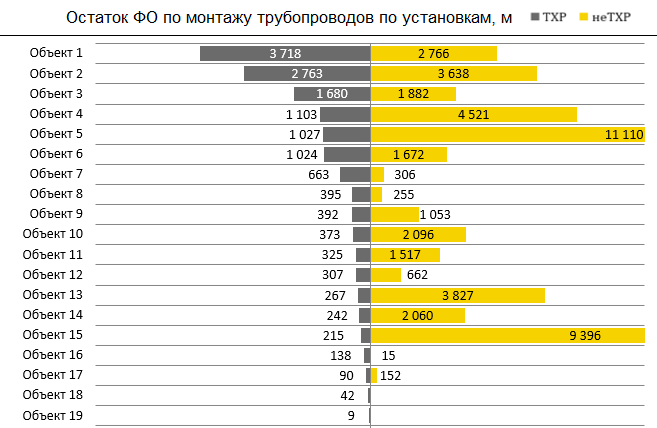
Next, we clarified which subcontractors are scheduled to perform this work.
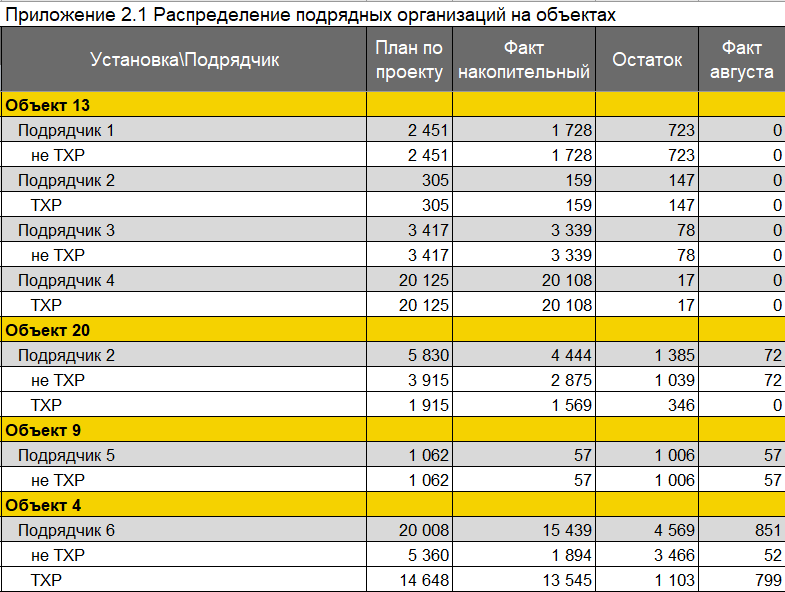
After this, we analyzed the output and pace of pipeline installation subcontractors for the reporting period, after which we identified those who are engaged in non-priority work at these sites (in addition to this, we identified those contractors who have large residual volumes for the installation of technical and chemical equipment, but they do not perform them).
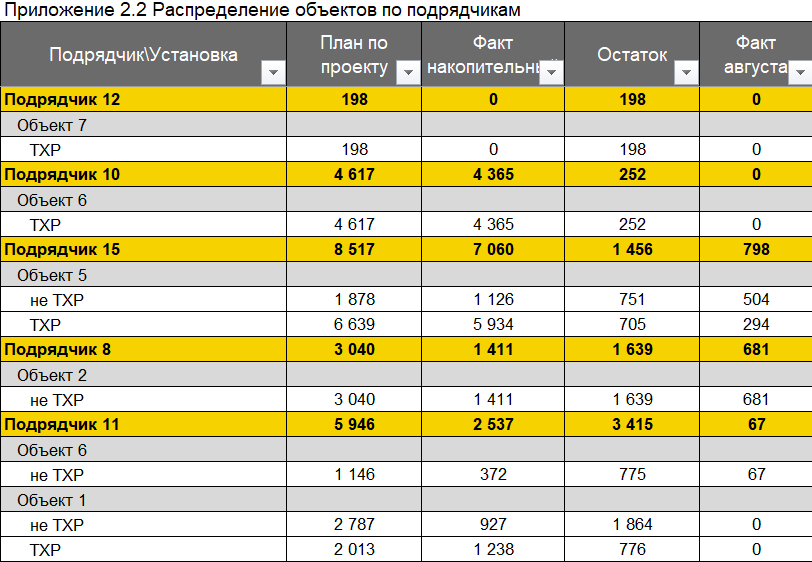
Based on the results of such analytics, the team was able, firstly, to send a request to subcontractors to complete priority tasks in the next time period, and secondly, to outline a plan for the redistribution of critical volumes to those contractors who had a good pace of work on the installation of technical and chemical reactors.
A week later, having made sure which contractors were able to speed up the completion of critical work, which continued to perform non-priority work, and which confirmed the possibility of taking on additional volumes of work on the installation of technical and chemical equipment, the team, together with the general contractor, began redistributing volumes between subcontractors. As a result, critical work began to be performed by those who had the resources and capabilities for this, and the resources of the remaining contractors were directed to other work (in accordance with the priorities obtained during the promotion of critical paths). Subsequently, the team kept this issue under regular control, monitoring the release of resources from contractors with high output and redirecting this resource to critical work.
As a result of the measures taken, the installation of process pipelines was significantly accelerated, which made it possible to quickly test them and confirm their readiness for operation. At the same time, the search for additional resources to speed up near-critical work continued.
Thus, having initially received analytical data from the schedule network model, the team made management decisions, taking into account external restrictions. Combining the model's calculations with the logic of the project management team resulted in faster completion times.
When using even the most modern management tools, we must not forget that they can be good assistants, but no system can replace the decisions of a person (who has the ability to analyze, make corrections and adjustments). This must be taken into account both when implementing various IT products and when training and developing the management team of large-scale projects and megaprojects.