
Memories of the future. Implementation of megaprojects in the USSR. Part 1
27.03.2025
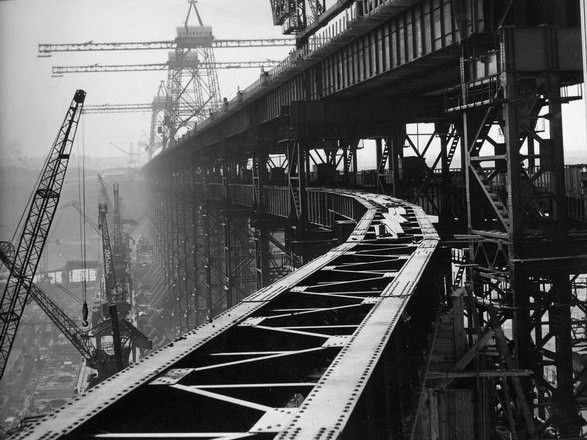
Photo. Construction of the Bratsk hydroelectric power station
In light of the ambitious tasks that our state and business face today, I would like to talk about megaprojects designed for several decades that were implemented in the USSR. Perhaps that experience can be useful to us today. These can be considered territorial production complexes (TPCs) - the implementation of large-scale tasks for the development of the territories of a huge country. The methodology for solving such problems was first formulated and scientifically substantiated in our country.
Released September 6, 2021 interview with the Minister of Defense of the Russian Federation, as well as concurrently the President of the Russian Geographical Society, Sergei Shoigu, who talked about plans to create a new infrastructure corridor in Siberia connecting Europe and Asia with the simultaneous construction of new city-economic centers ranging in size from 300 thousand. up to 1 million inhabitants and giving a new impetus to the development of Siberia with the creation of new scientific and industrial clusters.
If we recall the history of our country, the most scientifically substantiated and planned instrument for the development of Siberia was the TPK. And if you look even more broadly, the creation of a new large development center with up to 1 million people could become a mega-project to reformat the structure of the entire state with the construction of a new capital (like, for example, the construction of St. Petersburg and the surrounding industrial and production facilities at the beginning of the 18th century).
Most industrial industrial complexes were created on the basis of the then existing industrial centers, which gradually expanded. But there were also those that were created practically from scratch. As an example of the implementation of such a megaproject from scratch, consider the creation of the Bratsk-Ust-Ilimsk TPK.
History of the creation and implementation of TPK.
The concept of TPK was introduced into economic theory by the Soviet economist and economic geographer, one of the founders of the Soviet school of economic regionalization, Nikolai Kolosovsky in the 1940s. and was formulated as follows: "A territorial production complex is an interconnected and interdependent combination of branches of material production in a certain territory, which is part of the economic complex of the entire country or any economic region."
In Western economics, a term similar in description is "cluster" popularized Michael Porter in the book The Competitive Advantage of Nations (1990).[1]
The main difference between TICs and clusters as interpreted by M. Porter is the presence of competition within the cluster, which, according to many economic theorists, is the main driving force for increasing the efficiency of resource use. When creating the TPK, it was assumed that high efficiency would be achieved through integration and centralized distribution of resources.
There were 15 TPKs operating on the territory of the USSR, 6 of them in the east of the country.
In the Irkutsk region, the first to receive TPK status was the Irkutsk-Cheremkhovo industrial region, which included the Irkutsk hydroelectric power station, the Irkutsk aluminum plant (the main consumer of its cheap electricity), the Angarsk-Usolsk industrial hub (Angarsk petrochemical and Usolsk chemical plants) and the later built Sayan chemical plant. Each of these components can be safely called a megaproject in the modern sense of the term.
The creation of the Bratsk-Ust-Ilimsk TPK began on September 23, 1954. It was then that the Nizhneangaragesstroy Construction Directorate was created, later (January 2, 1956) renamed the Special Construction Directorate of the Bratsk Hydroelectric Power Station Bratskgesstroy.[2]
Brtasgesstroy was headed by Ivan Ivanovich Naimushin, and Aron Markovich Gindin [1] was appointed chief engineer (later I.I. Naimushin would become famous among business executives for the fact that under his leadership 11 hydroelectric power stations would be built on the Niva, Kama, and Angara rivers).
During November and December 1954, the first hundreds of construction workers repaired buildings in the village of Zavernyayka on the outskirts of the old town of Bratsk.
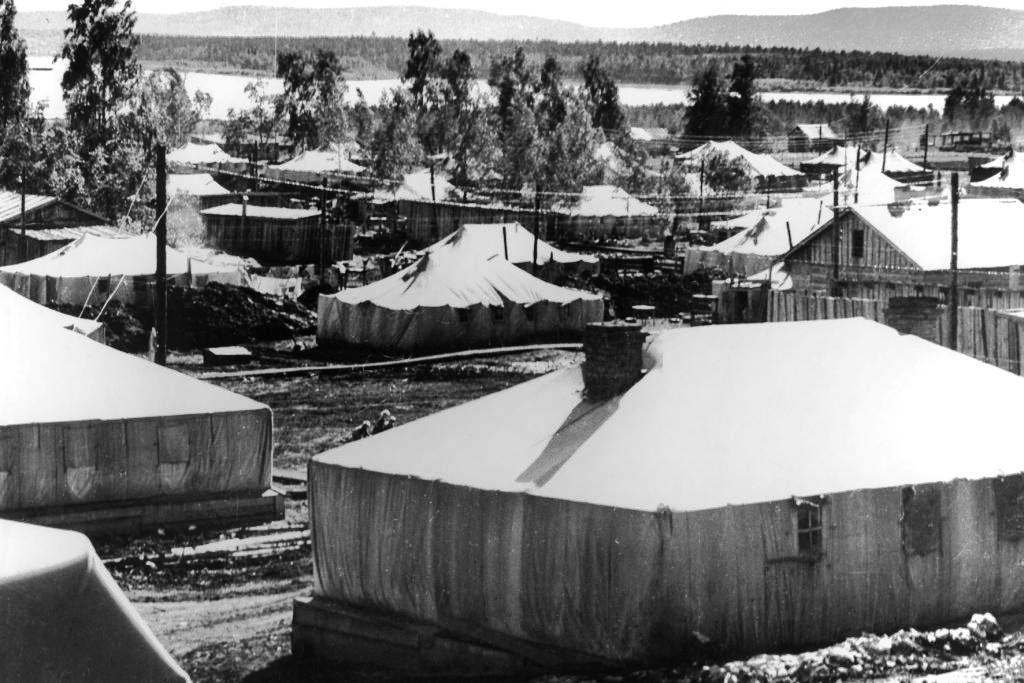
Photo. Tents of the first builders of Bratskgesstroy, 1954. The first tent was erected on December 9, 1954.
By the beginning of 1955, about 2 thousand square meters of housing and office space, a dining room, a cinema club, a temporary power plant building ZhES-30 and 1 thousand square meters of warehouse space were ready. A transshipment base was also organized at the Bratsk-2 railway station. At the end of January 1955, a winter ice road along the Angara riverbed from Bratsk to the village of Padun in the area of the hydroelectric station with a length of 35 kilometers was put into operation.
During the first full year of 1955, 25 thousand square meters of housing for hydroelectric power station builders, 5 thousand square meters of cultural and amenity premises, 30 thousand square meters of temporary buildings and structures for industrial purposes were built, work was carried out on the construction of the Irkutsk-Bratsk power line, 44.5 kilometers of railways were built, 62.5 were reconstructed and built km of highways, 35 kV, 6 kV and low voltage power lines were built for temporary power supply to the construction site (length 70 kilometers).
To carry out these tasks, in March 1955, 7 production self-supporting departments were organized: Padunsky SMU, Bratsk SMU, SMU Power Line, Department of Mechanized and Road Works, Department of the Chief Power Engineer, Department of Material and Technical Supply, Motor Transport Department. In October 1955, in connection with the need for further development of work on the right bank, the Osinovskoe SIU was created.
The construction area, remote from industrial centers, located in a sparsely populated and uninhabited area, was characterized by difficult climatic conditions with an average long-term temperature of -2.6 (78 percent of the year the temperature did not exceed 18 degrees). In addition, difficult conditions for working in open areas were aggravated by the presence of a huge number of midges from mid-June until the onset of frost. In 1958, an entomological site was created to solve the problem of midges. [2]
In 1959, when Bratskgesstroy was preparing to block the Angara River frontally, some foreign experts expressed thoughts that it would not be possible to block the Angara at all. Ambassador at Large of the President of the United States Averell Harriman came to the overlap. Apparently, he also did not believe that the Angara could be blocked, and when Naimushin with visible calm told him: "We have already blocked it," Harriman, who had previously only spoken English, suddenly asked in Russian: "How did we block it?"
After the overlap, Harriman asked to order a call to Washington... Naimushin instructed Petrov, the head of the communications department, to do this.
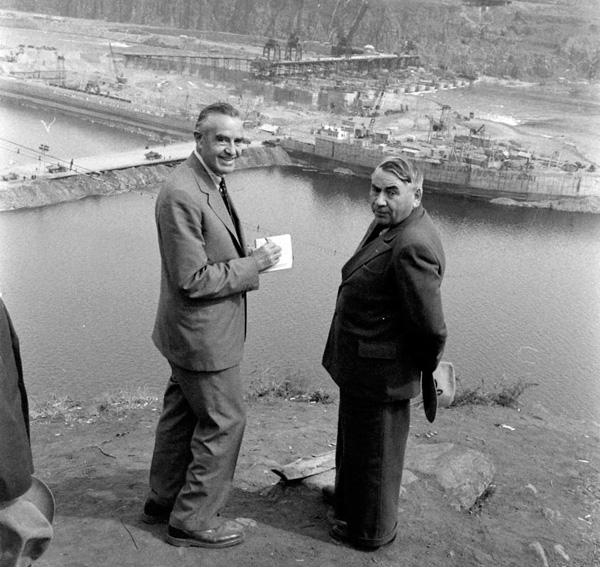
Photo. Ivan Ivanovich Naimushin and William Averell Harriman
It is known that Harriman spoke on the phone for 40 minutes, and then Bratskgesstroy received a bill for the negotiations of about $1,700. $1 at that time is approximately $10 in 2023. You can calculate how many rubles such a bill would cost today. However, after some time, Harriman paid off his debt. [4]
From 1955 to 1991, Bratskgesstroy was a closed-cycle construction organization; everything necessary for construction was manufactured internally at Bratskgesstroy's special production complex.
During the formation of TPK, such megaprojects were implemented as:
- Power line 500 - Irkutsk - Bratsk,
- Aluminum plant in Bratsk,
- Heating equipment plant (production of mobile boiler houses),
- Bratsk hydroelectric power station,
- Ust-Ilimsk hydroelectric power station,
- Boguchanskaya hydroelectric power station,
- Factory of prefabricated modular residential two-story buildings with finishing, electrical, and heating,
- Concrete concrete plant5,
- Concrete concrete plant6,
- House-building plant (the cities of Ust-Ilimsk and Zheleznogorsk were completely built from scratch)
- Korshunovsky GOK (iron ore plant)
- Ust-Ilimsk Timber Industry Complex and other equally large-scale facilities.
In addition, Bratskgesstroy provided itself with food with the help of the Bikei State Farm that was built. Children's camps and sanatoriums for TPK builders were also built.
Within the framework of the same TPK, coal mining was planned (development of the local coal basin), the construction of an Aluminum plant in Ust-Ilimsk (a site had already been selected), and the construction of the largest at that time in the world Turukhansk hydroelectric power station on the Yenisei.
In the mid-80s, the Bratsk-Ust-Ilimsk TPK became the center of development not only for Siberia, but also for the Trans-Baikal Territory and the Far East. The country's leadership issued a state task - to urgently raise and strengthen the heat and power complex of the Trans-Bakal region and the Far East. We also managed to complete this task by implementing several megaprojects. In the shortest possible time, power lines, thermal power plants, and state district power plants were built and completed in the Trans-Baikal Territory, in Blagoveshchensk, Khabarovsk, Komsomolsk-on-Amur, Nikolavsk-on-Amur and Sakhalin. Next, the task was set to create the Kansk-Achinsk fuel and energy complex (the largest network of thermal power plants in the world at that time). The construction of the Turukhansk hydroelectric power station involved the development of Evenkia, relying on the production base of the Bratsk-Ust-Ilimsk TPK. In the 1980s, construction began on the northeastern highway from Ust-Ilim to Evenkia.
Conclusion of Part 1
In the context of the gradual depletion of the resource base of Europe and the European part of Russia, the issue of developing new territories with new deposits and the construction of new industrial centers with the resettlement of a large number of people in their place becomes relevant again.
The development of the Bratsk-Ust-Ilimsk TPK is an example of the creation in a short time of self-sufficient industrial complexes with the simultaneous construction of the entire social infrastructure and the creation of favorable conditions for permanent residence of the population.
The history of the implementation of megaprojects of the Bratsk-Ust-Ilimsk TPK is a mechanism for developing the resource base of Siberia that has been worked out for decades, which should become one of the main factors in the development of Russia in the 21st century, and we will talk about some of the features of managing this mechanism during its implementation in the second part of our article.
Sources:
- Pletenny V.M., Tatarchenko L.V. Territorial production complexes: past, present and future (using the example of the Brastgesstroy SU) Journal Microeconomics 2011.
- Fund No. R-160. State Production Association "Bratskgesstroy" of the Ministry of Energy and Electrification of the USSR, Bratsk, Irkutsk Region
- https://web.archive.org/web/20210712171115/https://alertino.com/ru/389754 Fund No. R-160. State Production Association "Bratskgesstroy" of the Ministry of Energy and Electrification of the USSR, Bratsk, Irkutsk Region
- Man and his business (essays on the history of Bratskgesstroy). Moscow ENERGOATMIZDAT 1994. Essay by I.M. Maslennikov "The first years: to ensure construction"