
Project Management in Civil Engineering: Relationship between Schedule Delays and Project Performance
22.07.2025


PM Excellence presents the work of a Malaysian research team, published in the Built Environment Journal, to identify the key drivers of civil engineering delays among G7 contractors and their impact on productivity. The main problems relate to management, financing, staffing qualifications and project changes. Delays lead to increased costs, poor quality and safety risks. This study aims to explore the relationship between delay factors and performance of civil engineering projects. Planning, control, timely payments and digital monitoring tools are offered to minimize the impact.
Main objectives of the study:
- Identification of factors influencing delays in construction projects.
- Analyze their implications for project performance.
- Develop strategies to minimize delays and improve efficiency.
The study was conducted through a questionnaire survey among licensed G7 contractors in Malaysia. The sample included 144 respondents, whose responses were analyzed using descriptive statistics, Cronbach's reliability coefficient and Kruskal-Wallis test statistics. The findings identified key issues and offered practical recommendations to reduce the negative impact of delays in construction projects.
Types of Delays in Construction Projects
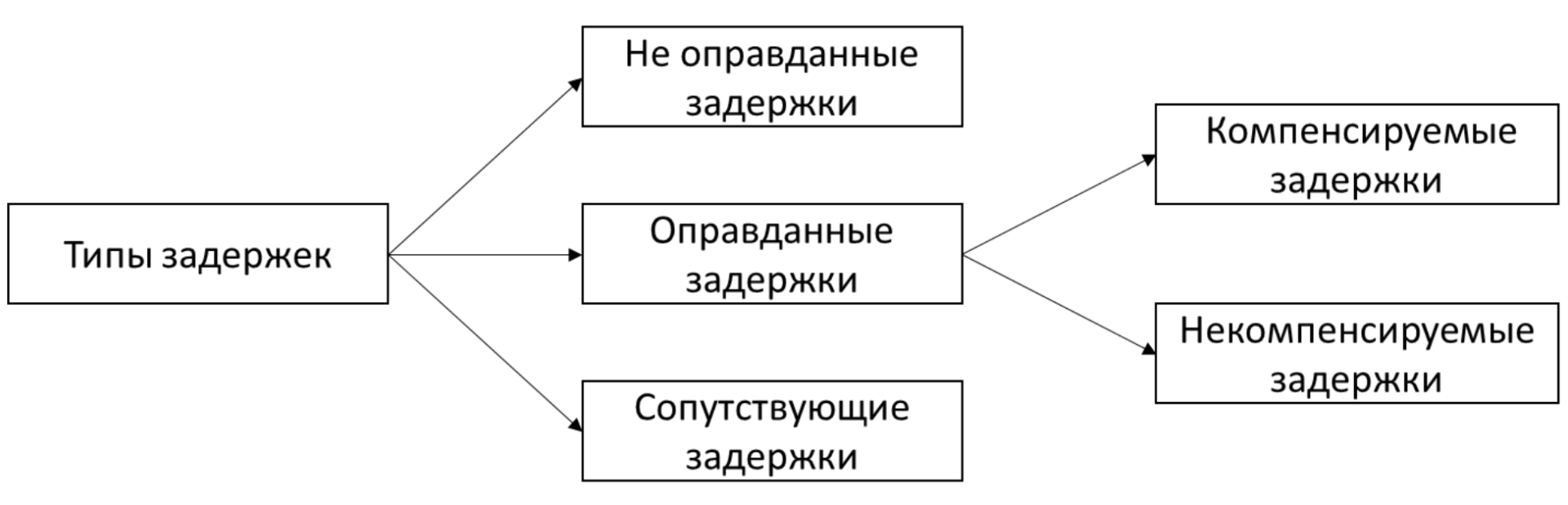
Construction delays are classified based on the causes and conditions under which they occur. Understanding the types of delays is necessary for the correct application of scheduling and project critical path analysis. The main types include:
- Justified delays - are provided for in the contract and allow rescheduling without penalties.
- Compensable delays are caused by the actions of the customer and entitle the contractor to compensation.
- Uncompensated delays - occur without the contractor's fault, but do not imply financial compensation.
- Unjustified delays - are associated with contractor errors, are not subject to compensation and may result in fines.
- Associated delays - a combination of several factors that overlap in time.
It is the use of a schedule network diagram that allows us to identify the interdependencies between these types of delays and assess their impact on the critical path of the project.
Excusable delays are permitted by construction contracts and entitle the contractor to an extension of time.
Compensable delays are due to employer actions, such as design changes or late submission of drawings, which allow the contractor to claim reimbursement or schedule extensions.
Uncompensable delays occur due to reasons beyond the contractor's control, but without the possibility of financial compensation.
Unreasonable delays caused by errors of contractors, subcontractors or suppliers do not provide for extensions of time or monetary compensation.
Contributory delays occur when multiple delay factors overlap or intersect.
Research methodology for this project
The study was based on quantitative analysis of data obtained through a survey of licensed G7 contractors in Malaysia. Methods of descriptive statistics and statistical tests such as Cronbach's reliability coefficient and Kruskal-Wallis test were used. This provided an objective assessment of delay factors and measures to reduce them. A Likert scale was used to assess delay factors, as well as an analysis of the relationships between scheduling and site efficiency. Particular attention was paid to the logic of constructing a schedule network model and highlighting the critical path of the project, which made it possible to better understand the impact of delays on deadlines.
Data were collected through a questionnaire among construction industry professionals (project managers, supervisors, engineers) with at least 5 years of work experience. A 5-point Likert scale was used to rate the importance of various delay factors.
Analysis methods
- Cronbach's reliability coefficient - α = 0.87 (delay factors), α = 0.70 (delay effects), α = 0.93 (delay reduction ways), which indicates the high reliability of the analysis tools.
- Kruskal-Wallis test was used to test for differences in the perceptions of factors among different groups of respondents.
Major Delay Factors in Construction Projects
Based on the analysis, the following key factors were identified:
- Weak company operating system - 4.21
- Insufficient financial stability of the contractor - 4.09
- Lack of experience on the part of the contractor - 4.07
- Frequent changes in project documentation - 4.06
- Low labor productivity - 4.06
- Shortage of building materials - 3.98
- Delays in mobilizing equipment - 3.96
- Problems with financing and late payments from the customer - 3.94
- Slow decision making on the part of the customer - 3.93
- Lack of technical competencies of the contractor - 3.87
Impact of delays on construction project productivity
Project delays harm several key metrics: schedule, budget, quality, and safety. Exceeding the deadline leads to budget overruns, deterioration in quality and risks for the contractor. Additionally, a disruption to the schedule causes a cascading shift in other tasks, especially those on the project's critical path. As a result, unscheduled adjustments and rescheduling of resources may be required, further increasing costs.
The most significant consequences:
- Exceeding deadlines - 4.34
- Over budget - 4.29
- Environmental consequences (for example, increased construction waste) - 3.83
- Decreased quality of work - 3.69
- Risks to worker health and safety - 3.43
Delays can have a cascading effect-increasing project costs lead to resource shortages, decreased quality, and increased defects, which in turn can lead to the need for rework and re-construction processes.
Effective Strategies for Minimizing Construction Project Delays
The study confirmed that the best results come from a combination of a proactive approach and digitalization. Key strategies include:
- Accurate project planning from the initial stage
- Application of schedule network planning and construction of a logical dependency model
- Use of progress monitoring software (eg BIM, MS Project)
- Financial discipline and timely payments to contractors
- Staff development
- Centralized supply and logistics management
The schedule network model provides a basis for making management decisions and allows you to track the critical path of the project, adapting to changes without significant consequences. The study results show that the most effective methods for reducing latency include:
- Planning your project before you start - 4.46
- Regular monitoring of work progress - 4.45
- Timely interim payments to contractors - 4.44
- Ensuring uninterrupted supply of materials and equipment - 4.37
- Selecting Qualified Contractors - 4.35
- Clear communication between project participants - 4.27
- Providing financing at all stages of construction - 4.22
- Systematic approach to risk management - 4.11
Conclusions and recommendations
In the context of the growing complexity of projects, scheduling and network planning is becoming an integral part of effective management.
Key findings include:
- The need to introduce digital planning models (including schedule network schedule)
- Increasing the role of the project's critical path in risk assessment
- Development of a personnel training system and standardization of processes
Implementing these recommendations will significantly reduce the impact of delays, ensure schedule sustainability, and improve the overall productivity of construction projects.
The study confirms that delays in construction projects are most often caused by internal organizational problems such as weak management, lack of financial resources, lack of experience and weak technical equipment of contractors, poor project planning, poor design and handling of schedule changes. Additional influence is exerted by external factors, including instability in prices for construction materials, political risks and changes in legislation.
To minimize the impact of delays on projects, you must:
- Improve project management systems, introducing digital monitoring and control tools that will enable scheduling, which will improve overall project planning.
- Strengthen financial discipline of contractors, ensuring the sustainability of their financing.
- Improve the qualifications of construction specialists, creating a system of certification and training.
- Develop mechanisms for effective interaction between customers and contractors, which will reduce the time spent on decision making.
- Create centralized logistics systems to ensure uninterrupted supply of materials and equipment.
Application of these recommendations will significantly reduce the impact of delays, minimize the risks of budget overruns and improve the quality of construction work.
Link to original article: https://journal.uitm.edu.my/ojs/index.php/BEJ/article/view/2424/1749
Sharuddin, N. M., Azman, M. A., Abdul Samad, Z., and Mohd Rodzi, R. (2024). Relationship between schedule delay factors and project performance in civil engineering. Built Environment Journal, 21 (special issue). https://doi.org/10.24191/bej.v21iSpecial issue.2424