
- Home
- News
- Articles
- All Articles
- General Project Management Issues
Guide: how to prevent a project from resurrecting (part 2)
28.04.2026

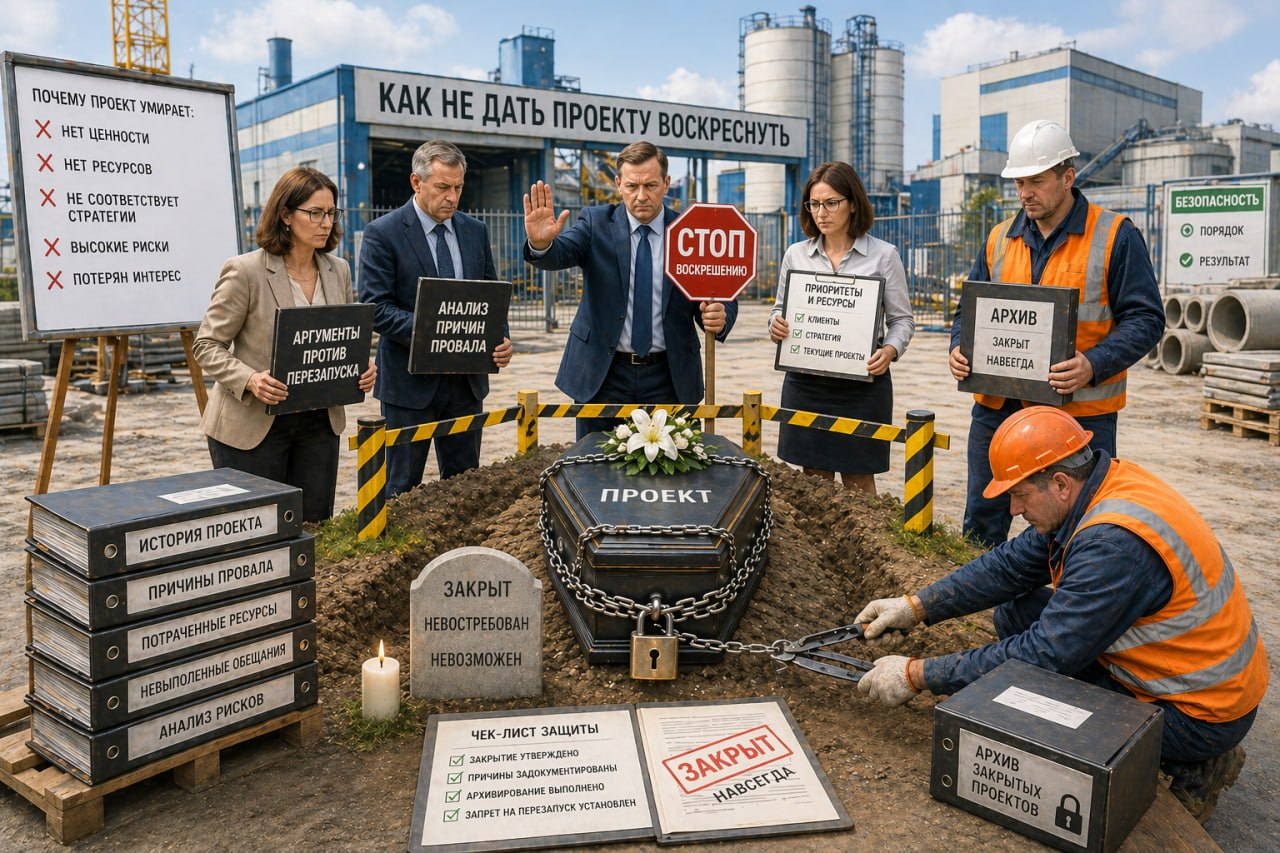
In the first part, we looked at how to bury a megaproject without violating any regulations. Now he rests on the laurels of past decisions and does not require unnecessary activity.
But practice shows: some projects turn out to be tenacious. Once you loosen control, suddenly sponsors' attention appears, there is talk of a "relaunch" and attempts to breathe life into it.
This is a dangerous moment.
If the project begins to come to life, it is important to prevent the main thing - the return of real control.
You need to act carefully. Here are 6 actions that keep a project in a state of controlled tranquility:
Action No. 1. Give birth in three months
A project loses its chance of revival when updated goals look strategically inspiring, but are obviously unattainable.
What to do: fix deadlines without connection with reality: without taking into account the current state of the project, resource limitations and contractual obligations.
Replace planning with a declaration of intentions.
Example: A project with an actual lag of 9 months receives a new goal: "to launch in 3 months." Without revising the plan, reducing the project timeline and scope of work, without mobilizing resources.
Formally, there is a goal. In fact, future failure is being recorded.
When the deadline is missed, the system already has an explanation: "the task was initially impossible." Responsibility dissolves. The project remains in the same place.
Result: any inflated goal works as an alibi for failure. No one is to blame if the "goal fails."
Action No. 2. Showcase of success
Management must see progress against the backdrop of overall failure.
What to do: select one indicative section, one that conditionally affects the launch of the entire object. Concentrate all your attention on it: people, equipment, materials.
Appoint a "reliable" leader from among trusted persons who will provide the correct picture and create the appearance of monitoring and control of the project. The rest gradually falls out of attention.
Example: Against the backdrop of a backlog, a site for installation of the main equipment is selected. Resources are being transferred there. The work is brought to visible progress: a high degree of readiness, a neat site, demonstrative control.
In the report: "Site readiness is 90%. The project is confidently moving toward launch."
At the same time, adjacent systems, without which start-up is impossible, remain in a critical condition. Infrastructure projects have not been started.
A showcase effect is created: local success replaces the real state of the project.
Result: reports indicate an increase in readiness. There is stagnation on the site. The system lives by the illusion of movement.
Action No. 3. Zhora, fry the fish. There will be fish
The supply crisis must be treated systematically. This means that the supply system itself needs to be improved. The result comes later. The main thing is the process.
What to do: strengthen the supply team. Bring it into a separate circuit and load it with "process transformation". Launch the development of regulations and automation. The more complex and large-scale, the better.
Example: Implementation of IT platforms: from automatic generation of requests to storage accounting and integration with suppliers.
The team daily "improves the process": configures, coordinates, optimizes. At the same time, procurement actually stops - because "the process is not yet stable."
The report increases the percentage of "systemically processed data at each stage" and records the "maturity of supply processes."
No connection to actual deliveries is necessary. The main thing is to create the feeling that the system is about to save everyone.
Result: Processes are improving - there are no supplies. Reporting is growing - the site is standing still.
Action No. 4. No unauthorized entry
Any new person is a risk, the effect of a "fresh look".
He is not built into the system and starts asking awkward questions. Sometimes he finds the real causes of problems.
What to do: maintain a closed loop of project management. Work only with "verified" ones. If attraction is inevitable, do not rush to integrate new people into the system. Hold them accountable for the problems they identify.
Example: a new manager with powers is appointed. He begins to act quickly, depending on the situation - sometimes even effectively. Initiates checks and raises uncomfortable questions.
He is promptly "adapted": any violation found becomes his area of responsibility. He either accepts the rules of the game or leaves the project.
Result: the system remains closed. Inconvenient questions disappear. Stability is more important than progress.
Action No. 5. Save everything at once
If you save everything at once, you won't save anything. Don't concentrate your efforts on the main thing, but load everyone evenly with everything.
What to do: distribute resources evenly. Keep everything a priority: everything urgent, everything important. Do not allow a local breakthrough, except for a controlled "showcase".
Example: Conduct weekly multi-hour meetings (5-6 hours) in all areas. Record: what was disrupted, what was not completed. For each item, make a decision to "correct by the next meeting."
Decisions are transferred, but always under the protocol. As a result, not a single task is completed. When everything is a priority, there are no priorities.
Local success is dangerous: one result is enough and the team will begin to gain momentum. And behind it the project will come to life.
Result: Meetings replace work. The protocol replaces the work schedule and becomes the result: problems are recorded, which means "Everything is under control."
Action No. 6. Kill two birds with one stone... project
Implement "rational" solutions that look like a breakthrough on paper: synergy, optimization, efficient use of resources.
Merge the project with another underlying project. Two weak people together are almost one strong.
What to do: make the most of everything that has already been purchased for other projects. Whether it is suitable or not is a secondary question. The main thing is to recognize this as an "intended use".
Example: There is equipment from another project in the warehouse. Why then waste time and money, purchasing new ones, if you can use what has already been supplied?
Yes, that's not it. Yes, not within these parameters. But "in principle applicable." We correct project documentation. And we start a chain reaction: recalculations, approvals, repeated approvals.
Raising one dead project is hard. Two connected - almost impossible. The system gets stuck.
Result: The project becomes complicated to the point of unmanageability. Bureaucracy replaces action. The revival of the project is postponed.
Important: follow the instructions. The project will remain in a state of controlled pacification - formally alive, in fact motionless.
The text is the result of synthetic work based on materials circulating in the professional environment and does not contain recommendations for action. The examples are arbitrary, the coincidences are random.