
- Home
- News
- Articles
- All Articles
- Schedule and network planning
Is it possible to forecast costs based on a schedule network model?

Is it possible to forecast costs based on a schedule network model?
The question is applied and frequently asked. Let's figure it out.
What does the theory say?
By "theory" I mean the international industry standard "Construction Extension to PMBoK".
There are two steps in the cost planning process:
-
Cost estimation - you need to calculate the costs of the project, for example, calculate that our project costs 100 rubles. The schedule network model is not used here.
-
Budget formation - you need to distribute these 100 rubles over time. For budget formation, the initial data is the schedule network model. That is, the theory directly says that time costs should be distributed precisely on the basis of the schedule network model.
Overall, the theory states that schedule and budget should always be in sync and not exist separately from each other.
What about in practice?
In practice, the topic of using a schedule network model when forecasting costs is generally workable and effective, but there are serious reservations.
From the point of view of the mechanics of the process, there are no technical restrictions within the schedule network model. All popular programs allow one way or another (in the form of direct costs or through resources) to assign costs to work and automatically distribute these costs over time, linked to the dates of completion of the work. Within a job, costs can be distributed in different ways: evenly, according to a mathematical function, or by manually entering data for each time period.
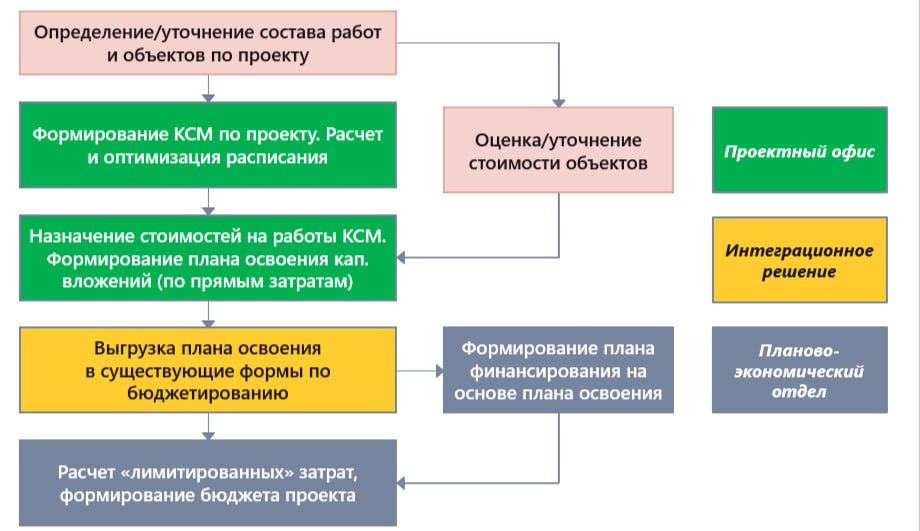
However, this data must then be transferred from the schedule network model to the project budget. Precisely in the program in which the budget is maintained, and precisely in the detail and structure of cost items that is in the budget. Here you need to clearly think through the interaction between the schedule network planning department and the financial department. (One of the options is shown in the picture for this article.)
It is not recommended to do the main structure of the schedule network model in terms of cost items. You can present the data of the schedule network model in the context of the structure of cost items through coding, grouping and layouts.
Data granularity: options
With details of the data, the options depend on the procedure for accepting and paying for work from contractors:
-
Paying by payment milestones is a relatively simple option. Here you need to compare payment milestones with the works of the schedule network model, and then the corresponding works can be coded and uploads regularly sent to economists based on the dates of payment milestones. In this case, it is not necessary to enter costs into the schedule network model. This scheme is quite simple and effective.
-
Acceptance and payment depending on the volume of work performed (as is often the case for construction and installation work, acceptance for construction work) is much more complicated. In this case, it is necessary to enter into the schedule network model the physical volumes of work and their unit prices, which in itself is labor-intensive, but feasible. The main problem is that at a construction site, the acceptance of work usually lags far behind its physical completion. The schedule network model will show a forecast for the physical execution of work, but not for its acceptance. In my opinion, it is unrealistic to predict the preparation of as-built documentation and acceptance of work in a schedule network model. And the budget (both in terms of development and in terms of financing) is tied precisely to the moment of signing the acts, and not to the moment of completion of the work.
Bottom line: Is it worth trying to predict costs using a schedule network model in such a situation? The question is ambiguous. I think it's more likely no than yes.