
The Golden Nail method: a fixed milestone as a tool for managing priorities in a megaproject
11.12.2025


Timely implementation of complex investment and construction megaprojects requires not only strict control of deadlines, but also flexible management of priorities under tight schedules. Although a detailed schedule network model is the main tool for these tasks, when using only "basic settings" it does not always provide the proper quality of management. In real time, it is necessary to quickly aggregate and analyze significant amounts of data, forming a unified and up-to-date picture of the project. Classic schedule management techniques often no longer meet these challenges, which requires their addition with analytical approaches.
Thus, focusing exclusively on the classical critical path when tracking fact and forecast against the baseline faces the problem of its dynamic nature. In a megaproject, several parallel critical chains may arise simultaneously, each of which requires attention and management. Every day there is a new "sight": after the next recalculation of the schedule, the critical path has changed, and the project completion date has shifted to the right. How to catch a tiger by the tail?
The solution is to use the additional functions of software systems in full, including the ability to manage "conflicts" in the schedule network model. This allows you to simulate a project schedule in the face of huge amounts of human data and customize views that give a different look at the usual schedule. Such approaches help highlight the truly critical points and turn the deadline into a priority management tool. One of these practices, which, in my opinion, has become an independent method, is the approach with the figurative name "Golden Nail".
History of application
The "Golden Nail" method was developed and tested at the construction site of industrial facilities. During the implementation of a large-scale project "Construction of the second stage of the Srednebotuobinskoye oil and gas condensate field" (Taas-Yuryakh Neftegazodobycha company), the PM Excellence team applied prioritization technology based on the analysis of critical chains with a fixed deadline for the analytical work of the Center for Rapid Response and Forecasting. This approach made it possible to reduce the backlog by more than 150 days and complete seasonal work in the northern region on time.
Name image
In the 19th century, the "golden spike" was the name given to the last spike driven in at the completion of a railway line. This symbol personified the triumph of the result and the end of a long journey. In project management, this image has been adapted to represent a key milestone with a fixed completion date for a project or phase. It is this point that becomes a constant reference point, from which the reverse calculation of the schedule begins and priorities are built.
Important Note: The Golden Nail method can only be used if there is a project schedule network model developed in accordance with the Project Management Standard, and preferably based on Oracle Primavera or its analogues.
The schedule network model is the basis for applying the method, which is especially effective for schedules containing over 3000 operations.
The essence of the "Golden Nail" method
Schedule and network planning is based on the classical principle: the only rigid fixed date is the start date of the project. All subsequent deadlines for milestones and tasks are calculated dynamically, based on the duration of the work and the specified logical connections between them. Any rigid fixation of intermediate dates in this approach is considered as a "conflict", which reduces schedule flexibility and distorts project duration calculations at the Planning stage.
The Golden Nail method deliberately violates this principle during the Implementation phase, creating a "managed planning conflict." Its essence lies in the rigid fixation of the final "directive date" of a project or key stage, turning it into an absolutely unchangeable and untouchable guideline.
This intentional fixation creates the effect in the calendar network diagram negative reserve work on critical chains when basic deadlines are shifted. The model is forced to rebuild the entire logic of calculations "from scratch" in reverse without shifting the end date, which leads to two key results:
- Identification of critical chains: All tasks and work sequences that do not fit within the given fixed deadline of the basic plan automatically become visible; they are expressed on a single critical path with zero and negative slack.
- Formation of priorities: management attention is focused not on a one-time "critical path" with a "loose tail" of project completion, but on a set of specific works of "critical chains" that require management intervention to eliminate the conflict with the deadline. This set of works should be ranked to provide a general understanding of the magnitude of the deviations and to measure the impact.
In this way, the method transforms the deadline from a passive control point into an active management tool that forces the project team to see the full picture of critical chains, rank them and focus on what is really important to fix in order to achieve the final date of the Baseline.
Let's look at a simple example of a "work package":
The classic critical path method builds a project schedule from left to right (early deadlines) and from right to left (late deadlines) to calculate slack. Tasks with zero slack form the critical path, a sequence of work that determines the minimum time for completing a set of works.
Figure 1:
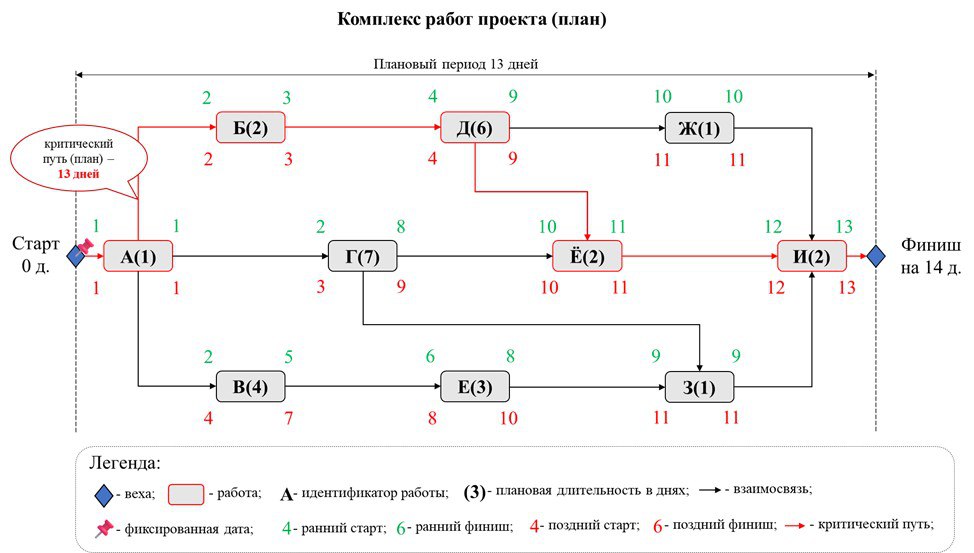
For each task, a slack time is calculated: "Slack" = "Late start" - "Early start" = "Late finish" - "Early finish"
The red line reflects tasks with zero slack in the critical path sequence:
A → B → D → E → I
Let me remind you that work on the critical path has priority for execution and allocation of resources, since there is no time reserve for these works. Failure to meet deadlines for at least one of the activities on the critical path can lead to delays in the entire range of work on the project.
Let's imagine a real-life situation: 5 days have passed, and the progress of the work was different from the plan. In the updated graph, the actual execution data changes the critical path. The critical path has the property of changing during the execution of work, and, in principle, there can even be several options at the same time.
Figure 2:
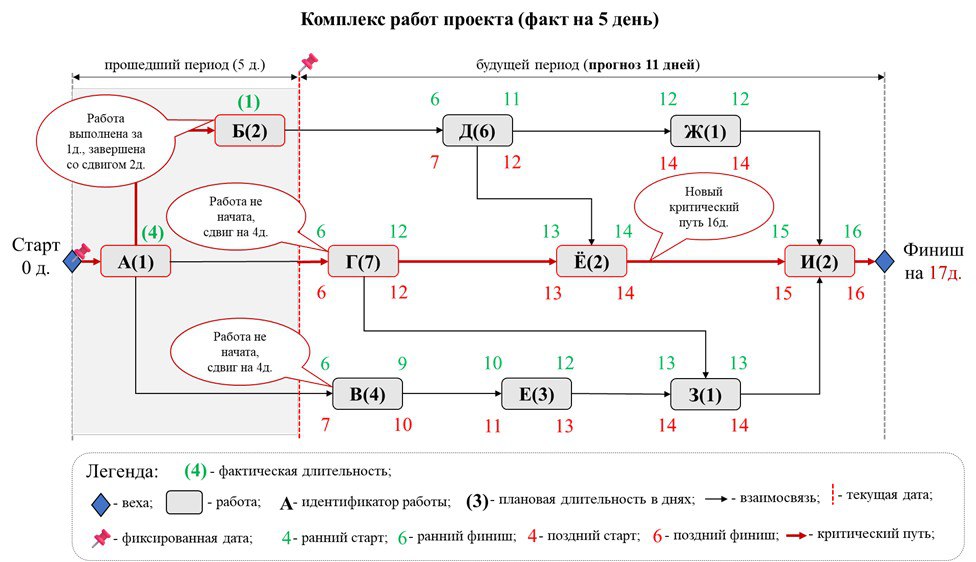
Due to the shift in the end of work A and the start of work D and C, the schedule shifts to the right (to later dates), and the completed work B gives only partial alignment. Particular attention should be paid to the fact that the starting point for calculating the critical path is no longer the project start date, but the current date. The resulting chain is: G → Yo → I becomes a new critical path as the duration of the critical path increases by 16 days.
Priorities have changed: G's work has come to the fore.
Of course, this is a simplified example of the classical model of calculating the critical path and setting priorities.
But consider this same example with an additional application of the Golden Nail method.
So, at the starting position we hammer in a "nail": we fix the end date on the chart from Figure 1.
Figure 3:
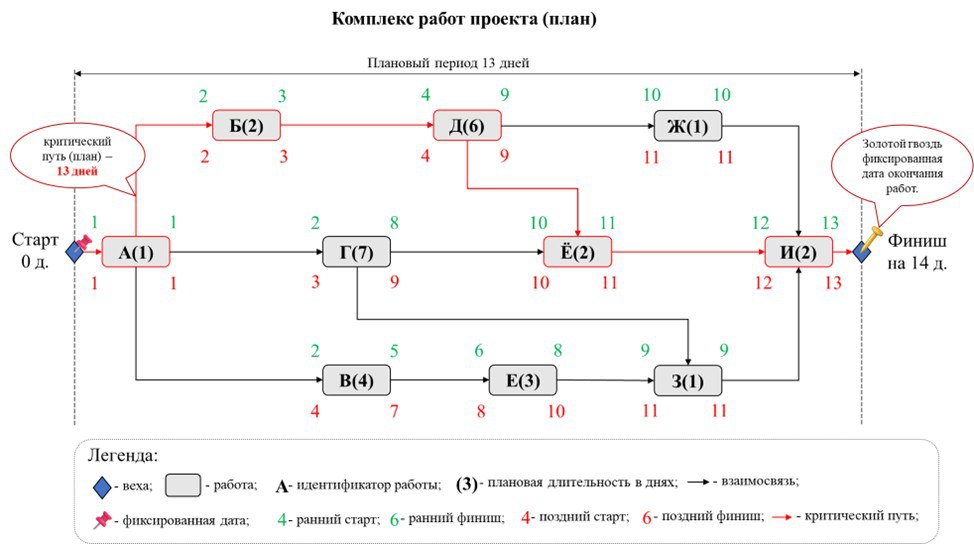
When the completion date is fixed as a "nail", the system generates tasks with a negative float when calculating backwards. As a result, after 5 days (as in the situation in Figure 2), the critical path turns into several critical chains.
Figure 4:
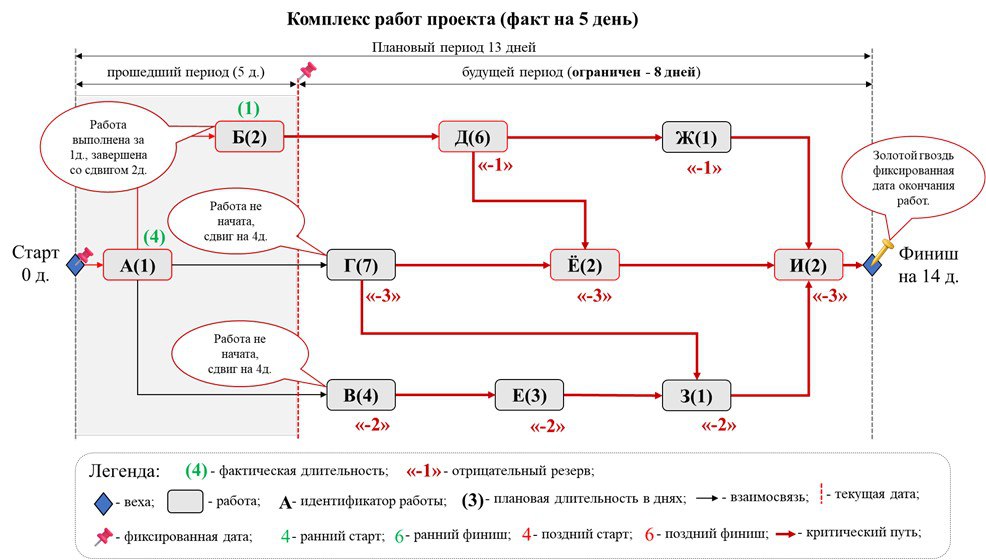
The emergence of the "negative reserve" indicator makes it possible to rank work according to the degree of criticality and concentrate resources where they bring the greatest effect.
These chains indicate overload zones and bottlenecks throughout the entire work package. With a compressed schedule due to a fixed completion date, it is the negative float that becomes the basis of the rating for resource management.
The main difference from classical practice is the formation of a single and ranked picture of all critical chains in real time with each recalculation of the project schedule.
Note: when working with SCM from 3000 operations, the final list of priorities may include several hundred works and activities with a significant spread of negative reserve values.
Table 1:
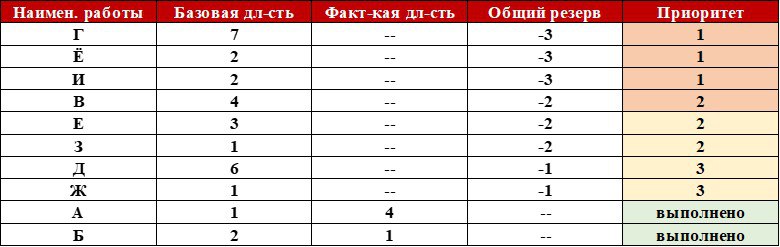
Table 1 is a clear example of the output data format for working using the Golden Nail method. This ad-hoc tool ranks tasks by criticality, generating a list for immediate intervention, and provides daily visibility into both progress and the effectiveness of corrective actions.
This approach is optimal for a project environment with strict external deadlines (seasonal window, production launch, product release), which is typical for industrial construction and complex engineering projects.
Brief description of the method
- Fixing the "nail": The model specifies a rigid (directive) date for the completion of the project work package on the target date (for example, December 31).
- Schedule calculation: after recalculating the schedule, the model shows tasks with negative slack (-1, -2, -3 days).
- Prioritization: Tasks with the largest negative reserve are recognized as critical; they form a list of priority work, taking into account the entire picture of the project.
- Root Cause Analysis: a "backward chain unwind" is performed from the task with the maximum lag to its predecessors to identify the source of delays that can be influenced.
- Taking action: resources are redistributed, relationships are revised, processes are optimized. The graph is then recalculated and new focal points are identified.
- New track "break the nail": When, during the implementation of additional activities, it becomes possible to complete a set of works on time or external circumstances change that establish new restrictions, a new date for completing the project stage can be fixed and the optimization cycle can be started again.
Optimization tools
- Redistribution of resources to critical areas.
- Execute tasks in parallel that were previously scheduled sequentially.
- Reducing the planned duration of work by increasing productivity within the limits of real possibilities.
Risks and limitations of the method
- Requires decision making: The method pinpoints bottlenecks, but does not offer ready-made solutions. Responsibility for choosing the optimal way to resolve problems (redistribution of resources, changing the sequence of work) remains with the project manager.
- Risk of team rejection: Constantly focusing on tasks with negative float creates a "perpetual fire" effect, which can lead to team burnout, loss of confidence in the success of the project, short-term decisions made at the expense of long-term goals, and an overall decrease in the quality of work.
- Does not cancel the basic plan: Frequently recalculating the schedule relative to a new "nail" should not change the basic plan. It is important to maintain it as a benchmark for assessing the overall progress of the project and managing stakeholder expectations.
- Does not cancel objective restrictions: The method cannot circumvent physical, seasonal or logistical limitations. An attempt to "compress" tasks that strictly depend on external factors (for example, on the sequence of equipment delivery or obtaining permits) without taking into account these frameworks is unacceptable.
Summary
The "Golden Nail" method is not just mechanical pressure through a strict deadline, but a systematic way of focusing managerial attention. It transforms the schedule network model from a passive monitoring tool into a dynamic operational management mechanism that allows:
- Proactively identify bottlenecks in conditions of high uncertainty.
- Objectively rank Data-driven (negative float) priorities.
- Concentrate resources on tasks that provide maximum impact to meet the key milestone.
This approach is especially valuable for megaprojects where the classical critical path is too dynamic and the volume of data does not allow relying on intuition. The Golden Nail provides that "single, up-to-date picture" needed to make informed decisions in real time.