Materials Supply Register: Why Construction Projects Go Off Track in Excel, Not on Site

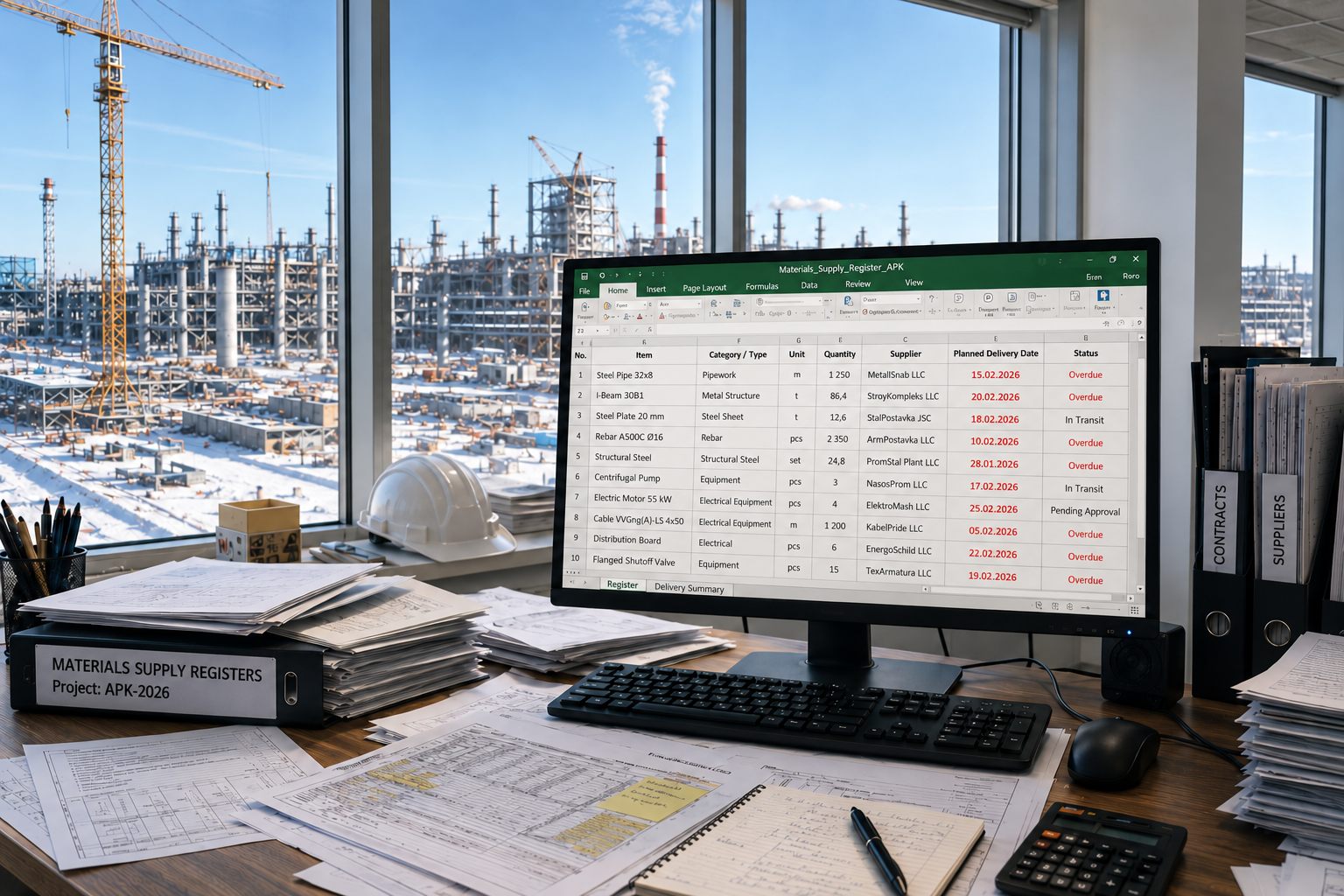
Most people involved in construction see a materials supply register as just another spreadsheet.
A list of materials. What needs to be purchased. In what quantities.
In practice, there is much more to it.
A materials supply register is one of the few tools that brings design, procurement, logistics, and construction work together in a single construction project management system. While a specification answers the question ‘What do we need?’ and a cost estimate answers ‘How much will it cost?’, the materials supply register answers four questions essential to managing deliveries:
- Where are the materials coming from?
- When are they being delivered?
- Where are they needed?
- In what batches are they being shipped?
This is where design quantities first become actual deliveries.
The problem is that most losses in construction are not caused by a lack of materials. They are caused by a lack of materials management.
On most construction sites, the materials do eventually arrive.
The question is whether they arrive in the right place, on the right day, and in the right sequence.
Construction rarely comes to a halt because there are no materials at all.
Far more often, it stops because the specific items needed are unavailable: they are in the wrong place, arrive at the wrong time, or are supplied in the wrong quantities.
That is why a materials supply register is not merely a procurement document.
It is a tool for managing the sequence of construction.
Where the Materials Supply Register Begins
Many people assume that the register first appears at the procurement stage.
In fact, its story begins much earlier.
Step 1. Detailed Design Documentation
Design engineers issue detailed design documentation and specifications.
This provides the first answer to the question:
What needs to be built, and what will it be made of?Step 2. Consolidated Materials Requirements
The specifications are consolidated into a single list.
The project's materials requirements take shape.
No logistics, suppliers, or delivery dates yet.
Just quantities.
Step 3. Two Separate Information Flows
From this point on, the information takes on two different lives.
The first flow feeds into the cost estimate.
Its purpose is to calculate the cost of construction.
The second feeds into materials procurement and supply planning.
Its purpose is to ensure that construction has the materials it needs.
At this stage, many people mistakenly assume that the cost estimate and the materials supply register should match.
In practice, they are different management tools serving different purposes.
Step 4. The Materials Supply Register Takes Shape
This is where the materials supply engineer comes in.
The engineer takes the design quantities and turns them into a model for managing deliveries.
Additional parameters are assigned to each item.
From where?
A specific supplier, manufacturer, or contractor.
When?
A delivery date linked to the project's network-based schedule.
Where to?
A facility, site section, zone, or work area.
In what batches?
A breakdown into batches that meet the actual needs of construction work.
The list of materials then becomes a management tool.
Step 5. Execution
Once project execution begins, the materials supply register starts working in the opposite direction.
It now records actual rather than planned data:
- who supplied the material;
- when it arrived;
- in what quantity;
- where it was transferred;
- who accepted the delivery.
At this point, the register becomes the link between the design and construction on the ground.
Why Good Registers Are Rare
In theory, the process looks flawless.
In practice, this is where many of the project's future problems originate.
Reason 1. Everyone Works Within a Different Frame of Reference
It is generally assumed that everyone involved in a project works with the same data.
In practice, that is not the case.
The cost estimator works with estimating standards and unit rates.
The materials supply specialist works with supplier catalogs, packaging requirements, minimum order quantities, and logistics constraints.
The construction team works from detailed design documentation and the actual installation conditions on site.
The result is a paradox.
Everyone is talking about the same facility, but using different data sources and different calculation rules.
The estimator sees cost.
The materials supply specialist sees deliveries.
The site foreman sees installation work.
Each is right in their own way.
Problems begin when these three perspectives fall out of alignment.
Reason 2. Design Changes
Managing revisions to detailed design documentation is a challenge in its own right.
Sometimes several approved revisions of the same drawing set are in use on a project at the same time.
The paradox is that everyone involved may technically be right.
Each is using an approved version of the documentation.
The problem is that they are different approved versions.
As a result, the design engineer is already working to Revision 5, the materials supply specialist is arranging deliveries based on Revision 4, and the contractor on site is still using Revision 3.
A revision is not a problem in itself.
The problem is the loss of synchronization between project participants.
This is where unnecessary purchases, material returns, rework, and contract amendments arise.
Reason 3. A Mismatch with the Cost Estimate
One of the most common questions on projects is:
‘Why don't the quantities in the cost estimate and the materials supply register match?’
Because they serve different management purposes.
The estimate shows the overall cost of construction based on standard quantities and unit rates.
The materials supply register deals with the realities of the supply market.
And that market plays by its own rules.
Suppliers sell cable by the drum.
Pipe in standard lengths.
Rolled steel in multiples of the mill's production units.
Equipment in complete sets.
As a result, procurement quantities almost never match the design or estimated quantities exactly.
The estimate assigns an indicative cost to a resource.
The materials supply register shows what will actually have to be purchased.
That is why differences between them are not an error, but a consequence of the different purposes these documents serve.
Reason 4. The Desire to Build the Perfect System
Paradoxically, problems can also begin when the materials supply register is working well.
As soon as a useful tool appears, people start improving it.
They add cost data.
They add contracts.
They add procurement.
They add inventory records.
They add execution tracking.
They add approval statuses.
Gradually, the tool accumulates more and more features.
Before long, maintaining the register itself takes more resources than managing deliveries.
This is a classic management trap.
Any system tends to consume all the attention and resources available to it.
So the question is not how much information can be added to the register.
The question is how much of that information helps people make decisions.
A Natural Question Follows
If all companies face the same problems, why do some use the materials supply register as a practical management tool, while others end up with just another complicated spreadsheet?
The answer usually lies neither in the software nor in the document format.
It all depends on what the company is trying to achieve with the register.
This is why we can distinguish several levels of maturity in the way a materials supply register is used.
Four Maturity Levels of the Materials Supply Register
1Level 1. Materials Requirements
| Drawing Ref. | Material | Unit | Quantity | … |
|---|---|---|---|---|
| ЭМ-101 | VVGng Cable 4×95 | m | 1,250 | … |
| ЭМ-102 | HDPE Pipe Ø110 | m | 480 | … |
The register contains a list of items and their quantities.
It is essentially an expanded specification.
It answers only two questions:
What do we need?
How much do we need?
2Level 2. Delivery Plan
| Drawing Ref. | Material | Quantity | Supplier | Delivery Date | … |
|---|---|---|---|---|---|
| ЭМ-101 | VVGng Cable 4×95 | 1,250 m | Kabel LLC | Jul 15, 2026 | … |
| ЭМ-102 | HDPE Pipe Ø110 | 480 m | Plast LLC | Jul 20, 2026 | … |
Suppliers and delivery dates are added.
The document begins to serve a logistics function.
Procurement can be planned and deliveries tracked.
3Level 3. Materials Supply Management Tool
| Material | Planned | Actual | Supplier | Status | Responsible | … |
|---|---|---|---|---|---|---|
| VVGng Cable 4×95 | 1,250 | 800 | Kabel LLC | At Risk | Ivanov | … |
| HDPE Pipe Ø110 | 480 | 480 | Plast LLC | Completed | Petrov | … |
The following are added:
- planned-versus-actual data;
- named people responsible;
- a link to the work schedule;
- monitoring and control of project variances.
At this level, the register begins to have a real impact on the project schedule.
Problems become visible before a delivery fails to arrive on site.
4Level 4. Integrated Project Management Tool
| Material | Design Rev. | Contract | Planned | Actual | Cost | Procurement Status | … |
|---|---|---|---|---|---|---|---|
| VVGng Cable 4×95 | Rev. 5 | ДГ-24 | 1,250 | 800 | RUB 3.2 million | Partially Delivered | … |
| HDPE Pipe Ø110 | Rev. 4 | ДГ-25 | 480 | 480 | RUB 0.8 million | Completed | … |
The register is linked to:
- detailed design revisions;
- procurement procedures;
- contracts;
- cost;
- inventory records.
At this level, the materials supply register is no longer a conventional list: it becomes a management register for the project's materials and equipment.
It is no longer a spreadsheet.
It is a digital model of materials supply for construction.
Interestingly, moving from one level to the next is not the result of implementing a new software application or ERP system.
It happens because the approach to management changes.
At the first level, the company keeps track of materials.
At the second, it manages deliveries.
At the third, it manages project risks.
At the fourth, it manages the project through its materials.
These are fundamentally different management models.
Where Effectiveness Reaches Its Limit
Here we encounter an interesting paradox.
The more information we add to the register, the more opportunities it offers for management.
At the same time, however, the effort required to maintain it also grows.
Eventually, a tipping point is reached.
The register becomes so complicated that people stop updating it regularly.
An outdated register is more dangerous than having no register at all.
Because it creates an illusion of control.
The Golden Principle
Over the years, I have come to a simple conclusion.
A materials supply register must be detailed enough to help manage deliveries.
And simple enough to keep up to date.
This is the dividing line between a management tool and just another spreadsheet maintained for the sake of reporting.
There is no universal template.
Each company must find its own balance.
Do not add complexity where it brings no management benefit.
But do not oversimplify where real losses of money, materials, and time begin.
One Final Thought
There is a common misconception in construction.
People think a facility is built from concrete, steel, and equipment.
In reality, it is built from decisions made at the right time.
The materials supply register is one of the tools that enables those decisions to be made before a problem reaches the site, helping the project actually meet its deadlines.
So the register is not a shopping list.
It is a system for managing the flow of materials over time.
Which makes it a system for managing the project schedule.
Because any material that does not arrive on time can very quickly become a delay to the construction schedule.
All Articles by This Author — link inactive