
- Home
- News
- Articles
- All Articles
- Project management in construction
When is project management applicable in construction?

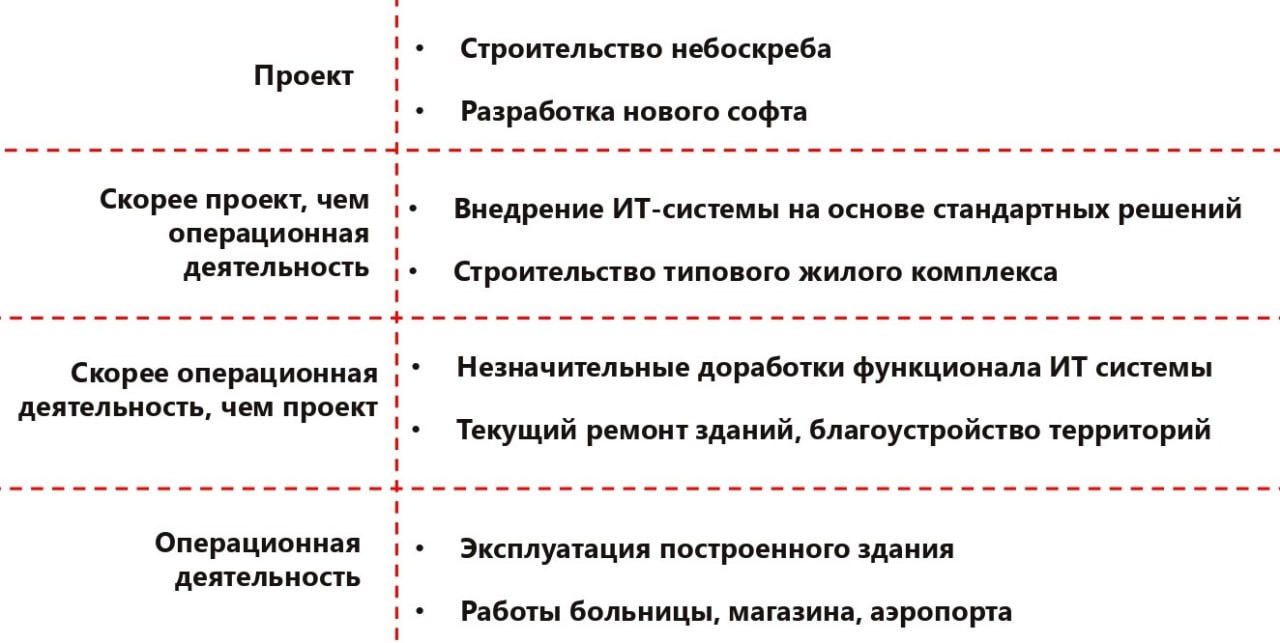
Project management is applicable to "project activities" (implies creating complex and unique results) and does not apply to "operating activities" (daily repetition of standard operations).
Where in construction is design activity and where is operational activity?
By definition, a project is always characterized by the presence holistic indivisible result. Which either exists or it doesn't. For example, we either put the facility into operation or we didn't. Either they received a positive conclusion from the Glavgosexpertiza, or they did not. The project result cannot be achieved by 60-70-80%.
Accordingly, all the work that needs to be done in order to get a result is a project. These works can proceed independently of each other, but in the end they must necessarily converge at one point.
If we can identify similar large indivisible results - we can apply a project approach to them.
Moreover, by definition, the project implies creating a unique result or service. Unique means something that no one has ever done before. For example, the first flight into space is a project in the 100% canonical understanding of this term.
To what extent can we say that the results in construction are unique, especially if we build similar objects year after year using standard technical solutions?
I'll answer this way: There is no clear dividing line between design and operational activities in construction. The general logic is that the larger and technically more complex the object, the more its construction corresponds to the concept of "project". Examples are in the picture above.