
What tools will help determine the status of the project and reduce its time? About the project's critical path and the S-curve of progress.

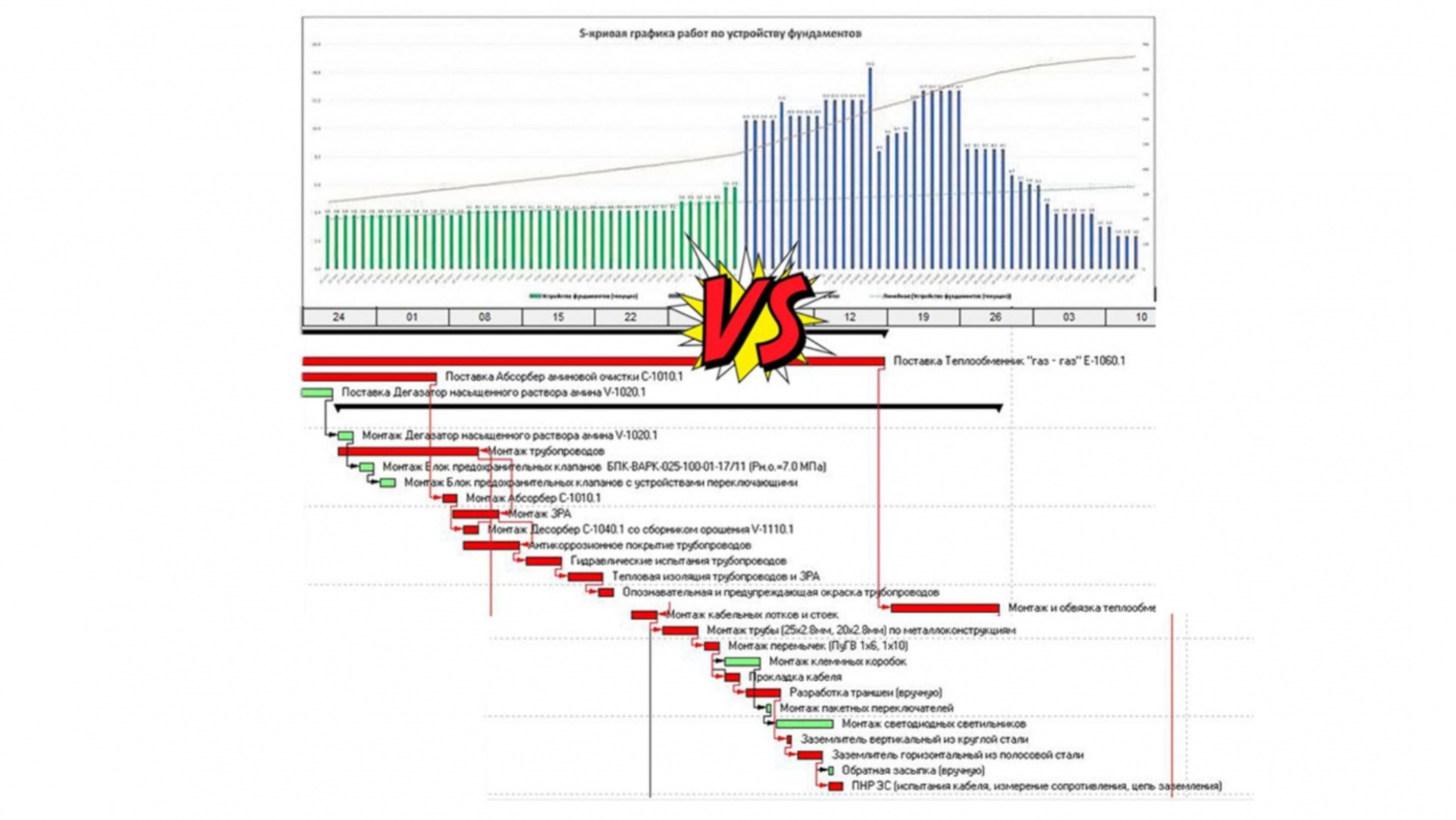
I would like to share my thoughts about monitoring tools for large-scale projects. Namely, about the requirements from top management, the owner or the owner of a large-scale project for approaches that would reflect the status of the actual execution of the project. Lately I have noticed that 2 main "schools" have emerged in the management of large and megaprojects:
1. Using cumulative total charts - S-curves.
2. Using the project's Critical Path method.
To begin with, I would like to make these approaches clear even to those who have nothing to do with Project Management or are just beginning to study this field.
Let's say I am the owner, and you have taken on the role of a manager to manage a large-scale project. Naturally, I would like to receive the status of the project regularly and make adjustment decisions in a timely manner. What is important to me in this case? At a minimum, I need: a baseline plan, an actual plan, and a completion forecast. And on a regular basis. For now we are only talking about timing. But the same will apply to the scope of work and the budget.
Let's look at these tools separately:
1. The S-curve mechanism graphically shows the total amount of work completed as of the current period. For example, there is a monthly plan for the release of project documentation in sheets. Every month we record the volume completed during that month and add all the volume already completed previously. In this way, a schedule network schedule is formed that has a constant growth or a horizontal profile if there is no progress. We come to the most important question - how can we use it? Having the shape of the planned S-curve, as well as the shape of the actual execution, we can track not only the deviation from the plan every month, but also see what rate of completion of the amount of work we have in our project. The trend will show over time whether we are accelerating, slowing down, or exactly according to plan (which almost never happens). That's all. The main benefit of plotting S-curves is trend.
2. Another approach is the Project Critical Path Method. It appeared back in the 50s and quite a lot has been written about it. In short, in any project there is a set of works that are technologically interconnected. With detailed planning, it is necessary to formulate a sequence of work and obtain a so-called schedule network model. At the same time, determine the start and end dates for each of the works. Today there are many software products that perfectly perform this task. Built-in algorithms will highlight for you those jobs that lie on the critical path of the project, do not have a reserve and determine the overall project completion time.
Such a tool will show the Project Manager which works are truly, calculatedly critical. And this will enable the Manager to apply influences to speed up those works that are critical and will reduce the overall project duration. We always use such methods on projects and call it "promotion of the critical path."
What conclusions have I drawn for myself and want to share with you?
1. For strategic management and for top management, S-curves will show the effectiveness of the implementation of the project or its individual areas. Based on this, senior management can mark the best Project Managers, see when efficiency was higher, when there were "failures" and take control of projects with "bad" trends in a timely manner.
2. The critical path of a project, on the contrary, is a tool that will provide precise knowledge of what work and how much needs to be accelerated so that the project is completed earlier. At the same time, the time frame by which we can reduce the project is known in advance.
General conclusion: It is wrong to oppose these instruments. It is more important to always remember the scope of application. S-curves will not give the Project Manager an answer to the question - what to do? Therefore, S-curves and trends are for top managers and Customers, and the Critical Path is for the Project Manager.