
How to reduce investment risks in conditions of uncertainty

Imagine that you are the owner of an oil company. You have permits to develop the licensed area. According to geological studies, recoverable oil reserves in the selected area are about 100 million tons. According to economic calculations, the development of the field will require investments in the amount of 150 billion rubles, and the profit if the project is successfully implemented can amount to about 300-400 billion rubles. At the same time, the probability that geological calculations may be erroneous and actual oil reserves will be several times less than expected is 50-60%.
I was once told an interesting story. One team was sent into the tundra to set up a well pad and drill several wells. Intensive work went on for many months, with overtime, struggle to meet the schedule - everything was as it should be. Then suddenly an order was received to "stop work, mothball the facility, and demobilize within 3 days." To the question and surprise of the team, "What happened?" the management calmly replied: "The geologists were mistaken, there is little oil here, and it is unprofitable to develop."
As this story shows, in the worst case scenario, the entire investment in a project can turn into a net loss. And such a scenario is very likely. At the same time, the size of the possible profit in a positive scenario looks very attractive. This happens at the initial stages of almost any major oil and gas industry project in the "Exploration and Production" direction: the risks are enormous, but the opportunities are also tempting. In this situation, maximum attention should be paid to the first stages of the project and strategies should be adjusted in a timely manner. Indeed, as implementation progresses, the cost of changes steadily increases, and the ability to influence the result decreases.
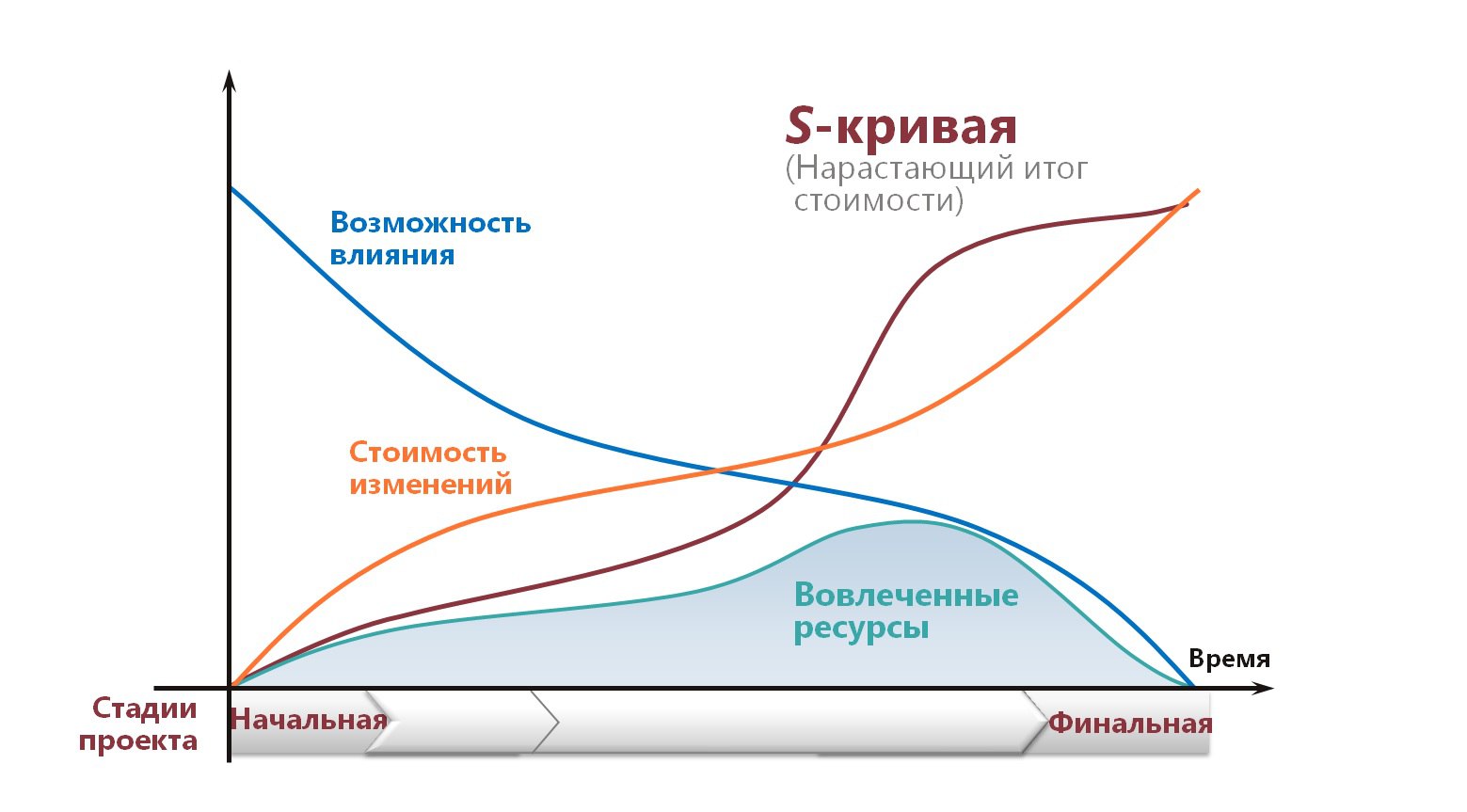
To take advantage of opportunities and minimize risks in such situations, many large companies have formed standards for managing large-scale projects and introduced a gated implementation model.
Gate model
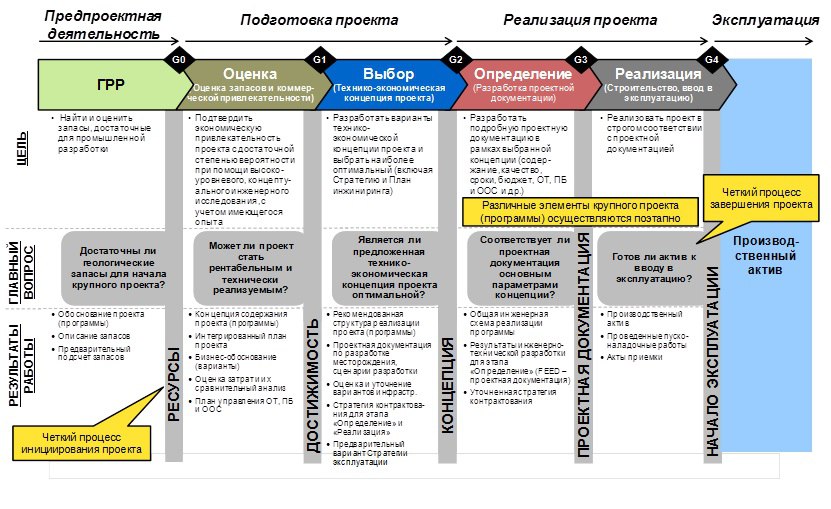
This method allows you to insure yourself and significantly reduce investment risks. The name of the model comes from the word "gate" and is translated as "gate". In order for the gates to move to the next stage of the project to open, a number of conditions must be met and appropriate decisions must be made. Visually, the gate model looks something like this.
Project implementation stages
In my projects I had the opportunity to work with three large oil and gas companies, their methodologies reflect generally the same principles. Work on the implementation of large-scale projects is divided into 4 stages.
- Evaluation. At this stage, additional research is mainly carried out to confirm data on reserve volumes. Costs are approximately 1-2% of the project cost.
- Choice. At this stage, conceptual design issues are first addressed. For example, how to ensure power supply to the facility - build a power plant at the field or connect to existing networks in the region and add 100 km of power lines for this purpose. Costs are in the range of 1-3% of the total project cost.
- Definition. Performing priority construction and installation work, conceptual design and development of documentation for the "PD" stage for the main part of the facilities. Costs at this stage range from 3 to 10% of the project cost.
- Implementation. The main scope of work on the project is being carried out: development of documentation for the "RD" stage, supply of materials and equipment, commissioning, commissioning of facilities. Costs at the project implementation stage account for about 90% of its total cost.
Even if the above costs are very relative, one way or another their peak occurs in the second half of the project. This is reflected in the gate model - the costs at the last stage "Implementation" are many times higher than the budget of the three previous ones.
Evaluation of project stages
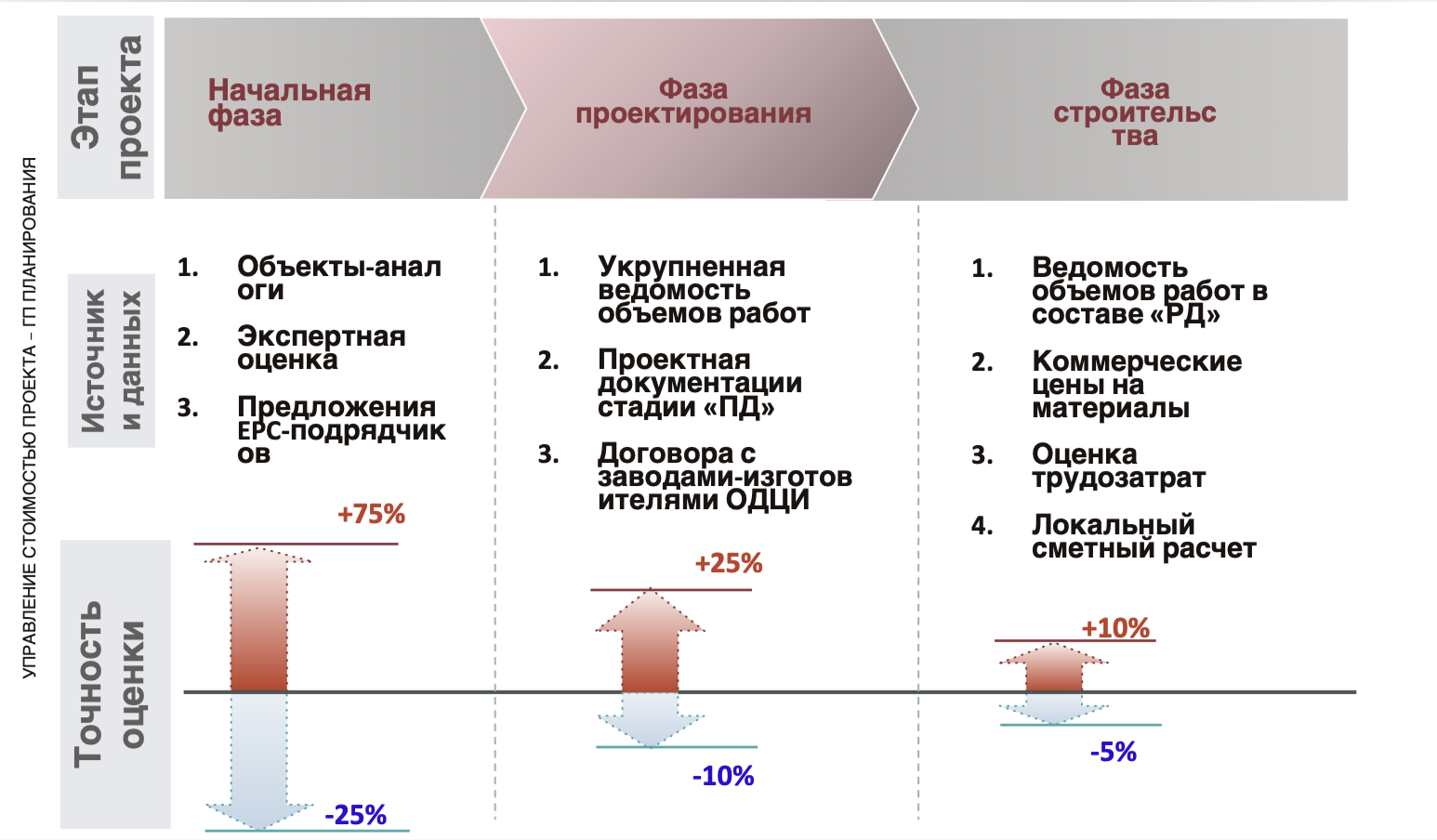
When initiating a large-scale project, its target economic indicators are determined. (For example, NPV, IRR, PI, payback period). These indicators are documented, for example, in an investment memorandum (IM). It also documents planned costs for a major project (CAPEX), macroeconomic assumptions adopted (oil price, dollar exchange rate, tax regime), key risks and other basic project parameters. At the same time, the error in estimating capital costs at the initiation stage of a large-scale project can be significant, but as the stages of a large-scale project progress, additional initial data for project planning appear and the permissible error in estimating the cost gradually decreases.
At the end of each stage of a large-scale project, the operator prepares a so-called decision package (DPP). It includes a report on the current status of the project and an implementation plan for the next stage of work. Additionally, it is necessary to conduct an independent examination of the project (cold-eye-review). It will help to give an objective assessment of the project implementation and will eliminate distortion of information in the report on the part of the operator. Misrepresentation of data by the operator is a significant risk, since the operator is an interested party - this has already been discussed previously article. The examination works best in a face-to-face format, when there is live communication between experts and representatives of the project operator, and not just a correspondence study of documents.
Case. In January 2015, I had the opportunity to participate in the examination of one of the large-scale projects at the Gazpromneft company. Then a "trooper" of 60 specialists from the corporate center from St. Petersburg arrived in Krasnoyarsk to visit the project operator. The examination took place over 3 days. Specialists were divided into 15 thematic round tables: drilling, geology, procurement, personnel, economics, project management and others. During each of the round tables, experts from the corporate center asked any questions and requested all the documents they were interested in.
Transition to a new stage
Carrying out an examination allows you to compare the plan with the fact. Based on its results, a decision is made either on further financing of the project and its implementation in accordance with the existing plan, or on adjusting plans and strategies. In the worst case scenarios, the examination may be followed by a decision to close the project.
Since the gate model implies a transition to the next stage of work only after making an appropriate decision, the economic indicators of the project are also updated here. The use of a gate model virtually eliminates unnecessary costs, since funding for the next stage of work is allocated only after an examination and report on the previous one. In other words, the gates of transition will not open until reports, metrics and expertise confirm that, based on the results of the previous stage, the project remains economically attractive.
Working on projects, by definition, involves being in an environment of uncertainty. In this case, the best a manager can do is to develop approaches and solutions that will take advantage of existing opportunities and minimize existing risks. The experience of the oil and gas industry in solving this problem can be considered advanced and used as an example.
My colleagues and I PM EXCELLENCE worked with gate models in many projects and combined their experience into a standard PM GATE.