
PM Excellence at Rosatom's "Dialogues with Experts": top 5 critical problems of megaprojects
21.08.2025
On August 6, in Moscow, the Rosatom State Corporation held a session "Dialogues with Experts" on the topic of planning and risk management in conditions of uncertainty. Among the listeners are project managers at various levels, employees of project offices, directors of investment services and capital construction departments from the nuclear industry and related sectors of the economy.
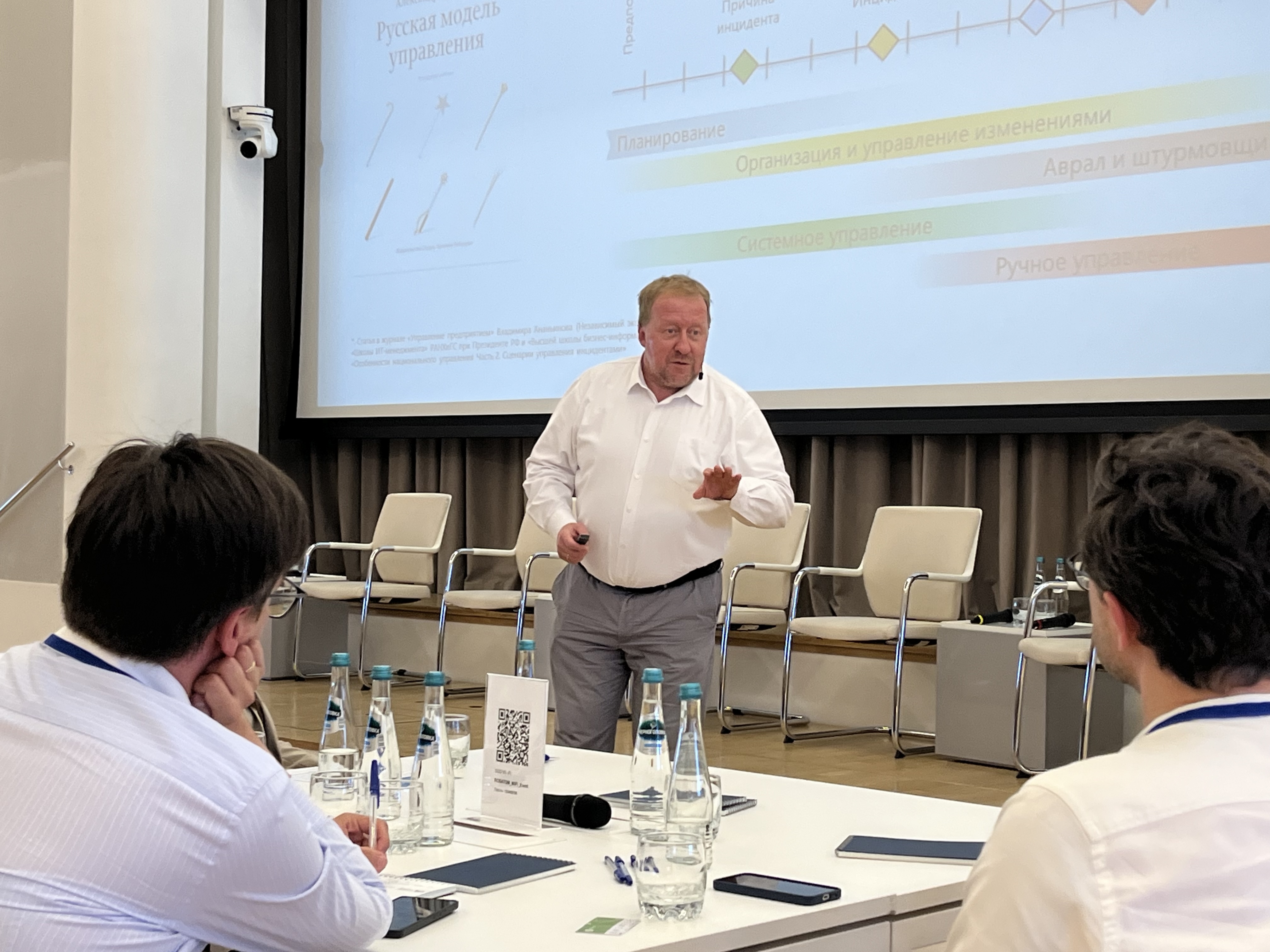
Senior Vice President delivered a presentation at the session PM Excellence Alexander Kutuzov, PME. In the presentation "Risks in projects - what we know but fail to apply. Why? Recurring failure patterns in large-scale projects at the implementation stage. Top 5" he presented a systematic ranking of the most critical problems arising during the implementation of megaprojects. Then there was a panel discussion on project risk management with the participation of leading experts in the nuclear industry.
Based on the results of a survey of project managers and directors of PM Excellence practices in 2025, Alexander Kutuzov identified five key problems of megaprojects.
-
The assessment presents its assessment of the magnitude of risks as the product of probability and degree of influence on a 100-point scale, explained Alexander Kutuzov.
Among the main risks were problems with logistics (67.8 points), overestimation of contractors' capabilities (74.5), lack of honest schedules (78.7), problems with managing priorities (83.5) and the leader of the rating - unqualified project management (88.9 points).
The problem of insufficiently qualified project management occurs in 95%+ of projects. It is the most critical - because of it, deadlines are missed by 75-150%, budgets are missed by 80-100%.
"Projects are often led by charismatic leaders who work intuitively, without a systematic approach. Project managers are technical specialists, not professional managers. As a result, manual control replaces systematic governance" Kutuzov emphasized.
Alexander Kutuzov also presented a comparative analysis of several national approaches to incident management. The Japanese model focuses on preventing incidents, the American one - on quick elimination, the Russian one - on quickly overcoming crisis situations that have already occurred through emergency situations and storming. According to the expert, it is important for Russian project teams to move towards the Japanese approach - preventing problems, rather than eliminating them after the fact.
Experts from JSC UMATEX, PJSC Inter RAO, LLC K4, LLC Gazprom TsPS and JSC TVEL took part in the panel discussion. Participants discussed key risk management issues: who should manage risks in the team, how risks should be reflected in schedule network diagrams, the introduction of the "Culture of Truth" and the transition from formal tools to real project management.
The event confirmed the high relevance of the topic of proactive risk management for Russian megaprojects. As Alexander Kutuzov noted: "Problems of implementation are always a story about management. In 9 out of 10 cases, it's not caused by external circumstances, but about systemic internal failures."