
Memories of the future. Implementation of megaprojects in the USSR. Part 2.
03.04.2025
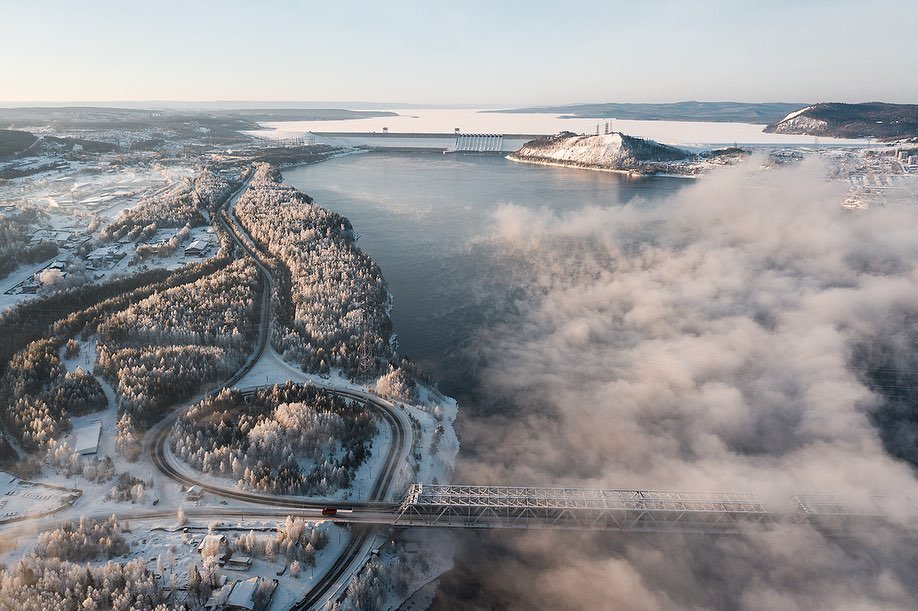
Photo: Roman Shalenkin. Ust-Ilimskaya HPP
The main problems in the implementation of TPK projects.
Lack of technical capacity
In April-May 1955, a lot of equipment came to Bratsk, the road to Zeleny Gorodok (a tent city near the Padunsky rapids) was opened, where the first sawmill was sent.
At that time, the head of the equipment department and the head of the installation department of Bratskgesstroy in the field of logistics was Pavel Dmitrievich Malkov:
"I remembered that there was a lot of unnecessary electrical equipment left in the Nivagesstroy warehouses. We made a good living there. Then I went to Osetrovo on the Lena, visited the bases of various departments, there was so much cable there, which was so necessary for the fraternal construction at that time... They managed to take it from there. We worked a lot with Glebov back then - he was an outstanding power engineer, in a short time he deployed temporary power supply to construction projects, they grew quickly."
Thanks to centralized planning and provision of material and technical resources throughout the country, it was possible to respond almost instantly to the needs of newly launched megaprojects and skip the period between receiving project documentation, purchasing, and production of materials and equipment necessary at the initial stage.
The Bratsk hydroelectric power station was initially planned for construction by order of the Ministry of Medium Machine Building for defense needs (producing "heavy" water).
The construction was supervised by Deputy Minister of Medium Engineering A.I. Churin. Thanks to this, the issue of equipping the 220 kV Irkutsk-Bratsk power line with all the necessary equipment was resolved in a short time, without which the deployment of the construction of the main hydroelectric power station facilities was impossible.
There was an urgent need to build housing in Padun; At the upper elevations in the village of Constantinople under construction, two RD-75 sawmills were deployed for the production of timber...
Meanwhile, in 1956, the Bratsk Hydroelectric Power Plant ceased to be of interest to the Ministry of Medium Machine Building, and there was a threat of its mothballing,
At this time, I. I. Naimushin showed himself to be a skilled politician. He was able to prove to the government that if the construction of the Bratsk hydroelectric power station, which had already had a great public and propaganda resonance, was mothballed, then the state would be a big political loser, since the development of Siberia would again be postponed to an indefinite future.
Important support at this stage was provided to Naimushin by the Chairman of the Council of Ministers of the USSR (analogous to the post of Chairman of the Government with broader powers) A.N. Kosygin[4].
Labor shortage
The construction industry being created in the developing areas of Siberia and the implementation of megaprojects required skilled workers. However, the majority of newcomers who came to Siberian new buildings were young people who did not have sufficient qualifications and experience. There was a need to organize her training in a wide range of professions as soon as possible. In conditions of an insufficiently developed network of vocational schools, the main form of providing construction sites with qualified personnel has become their training directly on site. Immediately in 1956, a training center for personnel training appeared. The training system in construction trusts developed simultaneously with the formation of labor collectives. The difficulty of its creation lay in the need to train new workers in a variety of specialties. Thus, during the construction of the Bratsk hydroelectric power station, they were trained in 135 professions. The number of workers annually trained in the construction of Siberian hydroelectric power stations and main oil and gas pipelines amounted to thousands of people. Only in Bratskgesstroy for 1956 - 1970. 79 thousand people were trained. [1]
In addition, there were government programs to attract the population to the construction areas of the TPK. Thus, salaries to employees were paid at a coefficient. 1.6 + northern coefficient 0.5 northern, it turned out that workers received wages 2 times higher than in the country. If an employee came from other regions, then the state apartment or the waiting list for it was kept at the place of his previous work and the employee could always return back to his usual way of life with family and friends, i.e. his "rear" was provided. There was also the title "Veteran of Bratsgesstroy". A person who received this title could count on various benefits and incentives, and the organization also helped them build cooperative apartments in other regions of the country.
Management structure
Bratskgesstroy was directly subordinate to the USSR Ministry of Energy, and on issues of planning its activities and providing construction projects, it directly interacted with the State Construction Committee and the USSR State Supply Committee
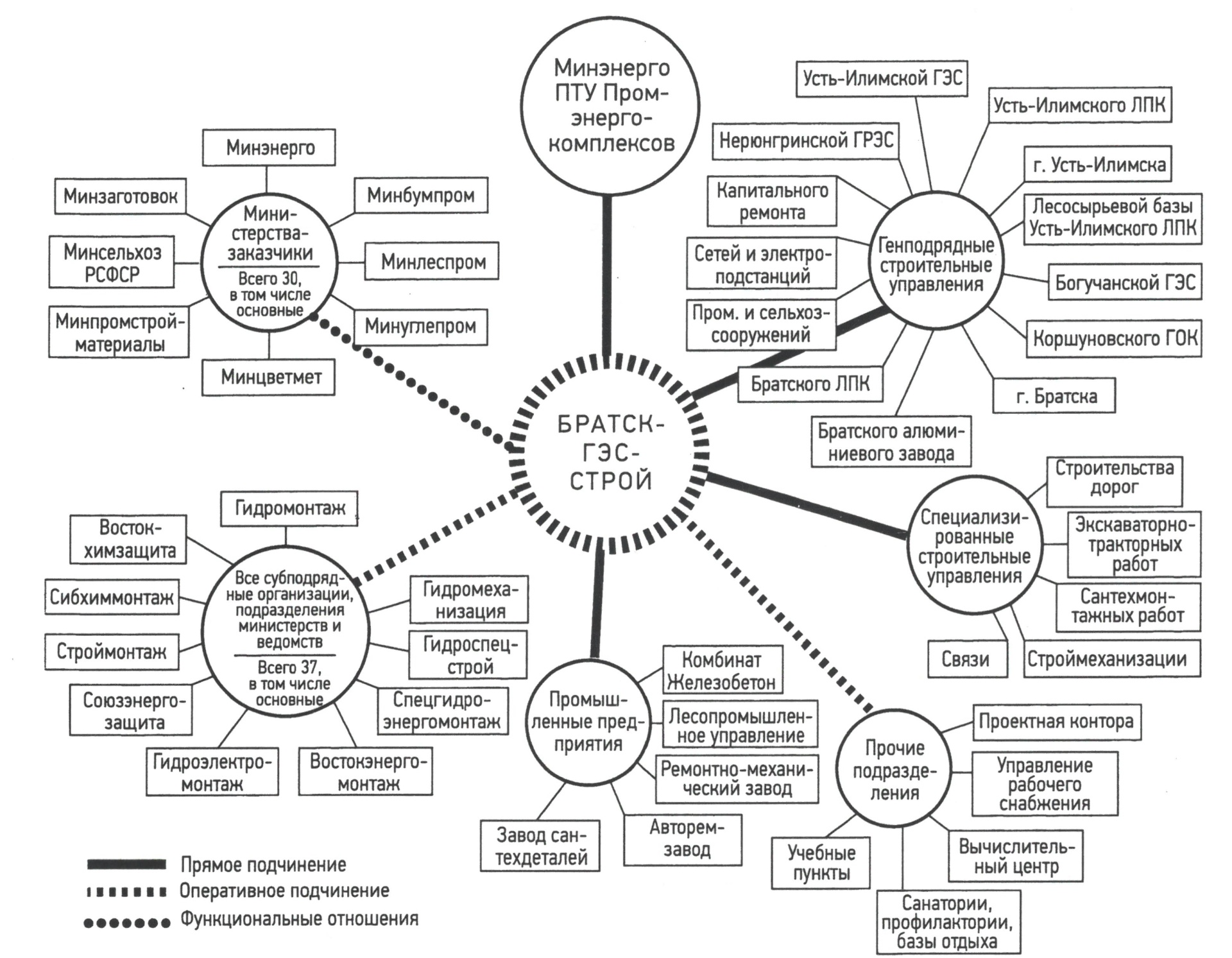
Drawing. Organizational structure of Bratskgesstroy and interaction with departments.[5]
Subsequently, Bratsgesstroy turned into a think tank and management center for subordinate enterprises, and in modern terms, became a corporate center, or the head office for managing megaprojects. Physically, the BGS occupied a small four-story building, which housed the Bratskgesstroy Office, planning department, accounting, and technical departments with a staff of only about 150 people. Bratsgesstroy was not engaged in production (operational) activities, but it included both general contracting organizations leading each specific construction project and being responsible for it, and specialized construction organizations (departments for road construction, excavator and tractor work, plumbing work, construction mechanization, communications, etc.), which carried out auxiliary work at all BGS construction sites.
"Directive" (based on parameters from the USSR national economic development plans for a five-year period) planning was carried out "from top to bottom" by establishing standard construction deadlines. Within the boundaries of "directive" planning, general contracting organizations drew up their annual plans, and such "bottom-up" planning began very early, from June of the current year to the next year. Such "counter" planning greatly helped to quickly control the situation, adjust the volume and composition of resources attracted to megaprojects in the event that certain parameters went beyond the scope of "directive" planning. In general, the structure was very flexible, allowing us to quickly increase capacity in breakthrough areas. This unique combination of power and flexibility made it possible to never miss the set delivery deadlines.
Bratskgesstroy managed the so-called "directive", and in essence, the largest construction projects. To implement each such megaproject, a special general contracting organization was created, and network schedules for carrying out main and auxiliary works were developed. Then the production preparation department turned these schedules for each complex being built into the so-called "Organizational and technical measures for the commissioning of complex facilities," which were developed by the general contractor and approved by the head of Bratskgesstroy. For each major construction project, a headquarters was created that weekly monitored the implementation of organizational and technical measures, deadlines, and carried out rewards and punishments. Based on the developed and approved plans, assignments were drawn up for subcontractors and specialized organizations. Work with designers was organized very effectively. In design institutes, special detailed design groups were created, which were directly located at the construction site. This made it possible for enterprises to resolve all design defects very quickly, directly at the construction site. Of course, inconsistencies arose thatwere promptly decided at headquarters meetings, where representatives of local authorities were also present.
An important feature in the activities of Bratskgesstroy was the so-called "cascading" in the construction of facilities: the construction of the Bratsk hydroelectric power station was still underway (started in 1954, completed in 1967), and construction had already begun on the Ust-Ilimsk hydroelectric power station (1963-1980), the Ust-Ilimsk forestry complex, and then the Boguchanskaya hydroelectric power station (construction began in 1980) - already as "pilot" facility for the next TPK.
Development strategy and construction of new territorial production complexes.
When the construction of the Bratsk TPK was completed and the volume of work was reduced, it became possible to transfer some of the management personnel and engineers (including some of the proactive and distinguished workers) to new megaprojects as part of newly formed enterprises. At the same time, old enterprises remained in working order. As a result, an experienced, well-coordinated team from existing enterprises came to the new construction site and, if necessary, advised new construction projects. Thus, the entire structure that had connections with the old one moved to the new construction at the same time, starting with the workers, ending with the management of the general contractor, into which new personnel were gradually poured. Communication was established both within and between organizations. And if it was necessary to increase the pace of construction, then organizations that were "almamaters" could come to the rescue and increase the pace of construction on a rotational basis. Continuity was ensured for several decades to come.
At the same time, general contracting organizations were very powerful structures, managing several objects and being in constant communication with each other to maneuver resources. For example, the construction of the Ust-Ilimsk LPK was carried out by the general contracting organization of the Ust-Ilimsk LPK, but workers and engineers from the Neryungri Hydroelectric Power Station Construction Department also worked there[1].
Conclusion
Bratskgesstroy implemented management approaches that were advanced at that time:
- Project management. A goal is formulated, a multifunctional team is created, the necessary resources are planned and allocated, network planning is used, integration is carried out, and risk management is implemented.
- Leadership. Painstaking work to select the most effective leaders, a mentoring system at the initial stages of their upbringing, the opportunity to test oneself in decision-making, their implementation and responsibility for the result obtained.
- Training and knowledge management. Training employees through a mentoring system, a systematic approach to the development and implementation of projects on time. Knowledge remains in Bratskgesstroy, as successful managers move from one BGS structure to another. The organization's use of knowledge for the construction of new facilities and the use there of the experience of already completed or nearing construction projects.[1]
An analysis of the experience of managing large territorial production complexes in the Soviet Union can be very productive in the creation and management of future state corporations or other management tools for the development of Siberia, the Arctic and the Far East and the effective implementation of megaprojects for the development of the national wealth of the Russian Federation and improving the standard of living of the citizens of our country.
Sources:
- Pletenny V.M., Tatarchenko L.V. Territorial production complexes: past, present and future (using the example of the Brastgesstroy SU) Journal Microeconomics 2011.
- Fund No. R-160. State Production Association "Bratskgesstroy" of the Ministry of Energy and Electrification of the USSR, Bratsk, Irkutsk Region
- https://web.archive.org/web/20210712171115/https://alertino.com/ru/389754 Fund No. R-160. State Production Association "Bratskgesstroy" of the Ministry of Energy and Electrification of the USSR, Bratsk, Irkutsk Region
- Man and his business (essays on the history of Bratskgesstroy). Moscow ENERGOATMIZDAT 1994. Essay by I.M. Maslennikov "The first years: to ensure construction"
- Experience in creating the Bratsk-Ust-Ilimsk territorial production complex: to the 60th anniversary of the formation of Bratskgesstroy. Moscow: Innovative mechanical engineering, 2015.