
The Dark Side of the Project Triangle: Stupidity, Greed and Irresponsibility
15.07.2025

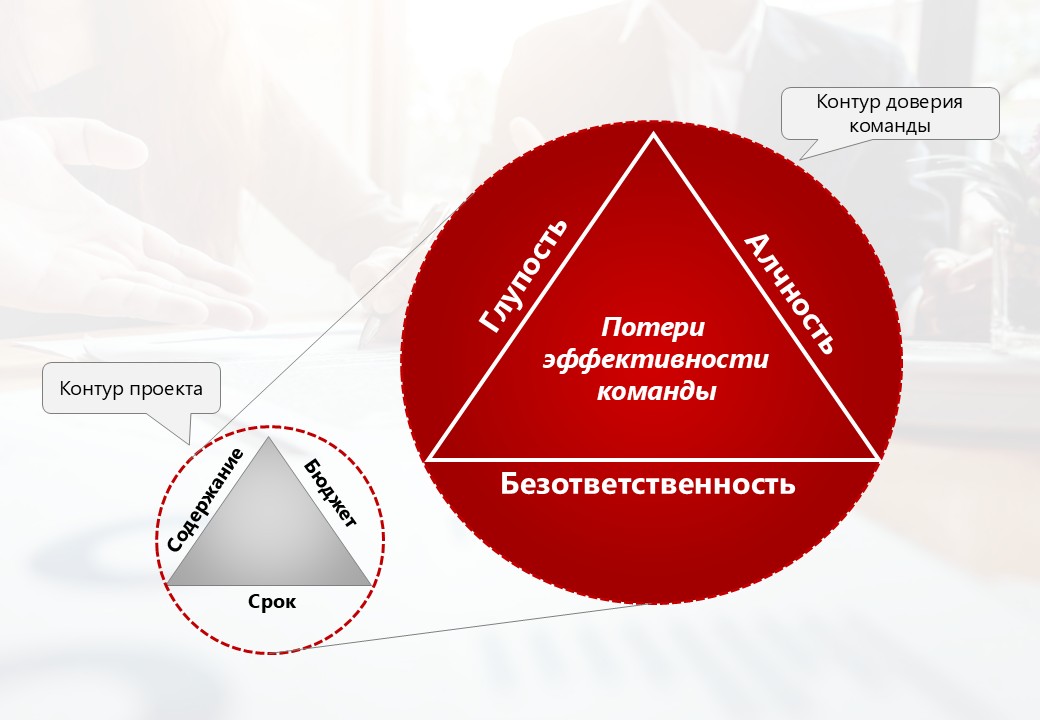
The practice of managing large-scale projects is not only a source of valuable experience in solving problems, but also forms a collection of observations in work records. I'm going to share some of the notes regarding emotional management of a project team, which reflect the patterns of the main causes of organizational problems.
Stupidity, greed and irresponsibility are destructive factors that can not only disrupt, but completely destroy the positive dynamics of team building, disrupt teamwork, plunge it into a state of uncontrollable crisis, which inevitably entails the collapse of the project.
First, it is necessary to clarify the basic terms in the context of the presentation:
Stupidity - this is not just a lack of intelligence, but rather a lack of proper competence, lack of knowledge or reluctance to acquire new ones. It manifests itself in making decisions based on a superficial understanding of the problem, ignoring expert assessments and persistently following erroneous assumptions. This recklessness, coupled with self-confidence, can sink even the most promising project, burying the resources and efforts of the entire team under the rubble.
Greed - a destructive force, manifested in the desire for personal gain, obtaining momentary economic privileges to the detriment of the interests of the project. Greed creates conflict, undermines trust within the team and between stakeholders, and degrades the quality of the final result, turning the project into a means of profit for individual participants.
Irresponsibility - this is a refusal to undertake obligations and/or avoidance of making decisions, shifting responsibility to others. Irresponsibility blurs the boundaries of responsibility, provokes conflicts and demotivates the team. A project in which irresponsibility reigns is doomed to miss deadlines, exceed budget, deteriorate quality and, as a result, unsatisfactory results.
It is worth recognizing that these three phenomena are present in varying concentrations in every project, since people are direct carriers or indirectly contribute to them. They underlie most project management failures, throw teamwork into chaos, and cause most organizational failures.
The main observation: stupidity, greed and irresponsibility undermine the controllability of the project, appearing and aggravating as interrelated elements. These are not isolated shortcomings, but complex, interrelated phenomena that penetrate the project at all levels and in various forms, which emphasizes the need for an integrated approach to project management that takes into account the interrelationship of these factors.
To make it easier to perceive the interrelations of three factors - defects in a single system of deviations from popular standards, let us recall the graphical model of the "project triangle", where the sides correspond to the content, deadline and budget, reflecting the interdependence of the main constraints of the project. Let's imagine the dark side of the graphic model, where the sides embody stupidity, greed and irresponsibility.
The dark side of the design triangle:
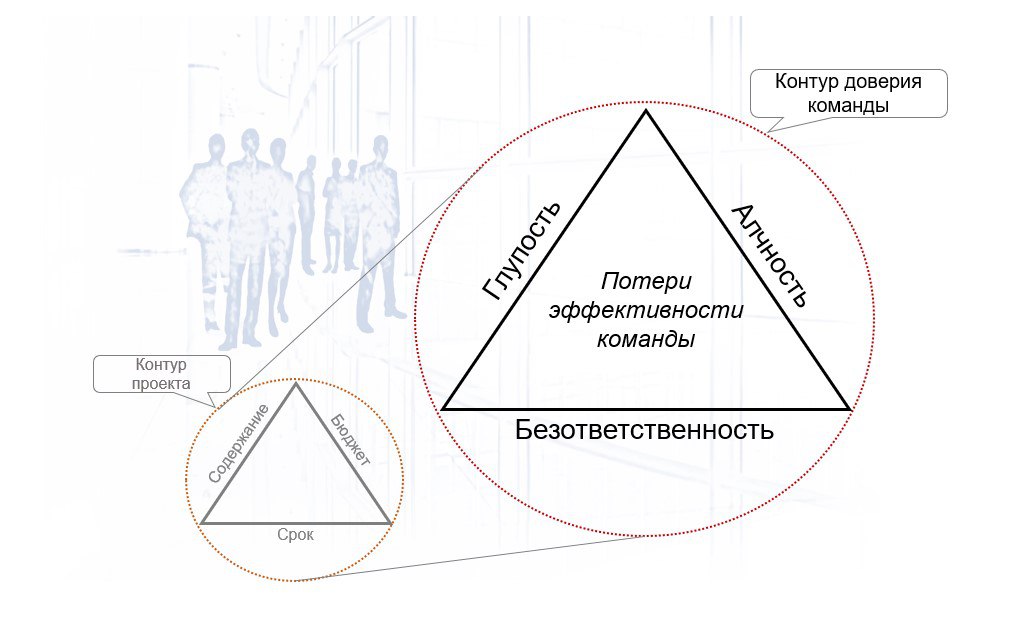
When one side of the dark project triangle-be it stupidity, greed, or irresponsibility-engages in actions or inactions that have negative consequences for the project, it inevitably sets off a chain reaction that affects the other two sides. Loss of balance in the team's trust circuit leads to the spread of these vices, which reinforce each other according to the principle of proportional dependence: the strengthening of phenomena in one area entails changes in others, aggravating the overall situation. Thus, each side of the triangle is a source of aggravation of the vices of the conjugate sides. That is, where stupidity is encouraged, greed inevitably manifests itself, expanding irresponsibility. As a result, project participants lose the ability to interact openly, motivation, initiative and coordination of actions decrease
To better understand the essence of the presentation, let us recall the basic concepts from project management standards:
Successful project is the result of coordinated team work based on knowledge, honesty and mutual responsibility.
Project team - an association of specialists who work together to achieve a common goal and are responsible for specific project results.
Project management technology requires, for the successful implementation of a project, the involvement in the team of specialists from all organizations participating in the project: from the investor, the customer to suppliers of services, equipment and materials. Dividing the project team into "Client" and "Contractor" is an ineffective approach; contractors should be considered as part of a single team. To ensure coordinated work, it is necessary that key representatives of each are constantly in the common information space of the project and have clearly defined powers.
Now we will not discuss in detail the topic of creating strong partnerships in the project team. This topic deserves a separate discussion and is closely intertwined with planning and control of communications, management of contractual relations. The main thing is to emphasize for yourself the scale of the project team and the "diversity" of its participants, on which the success of the project depends.
Since the project has a clear time frame, the project team is a temporary association of participants. During its existence, the team goes through stages of formation, transforming from a group of individual specialists into a cohesive team. An effective team demonstrates the flexibility to quickly adapt to changing conditions, find optimal solutions to complex problems, and thereby increase stakeholder satisfaction.
Loss of team efficiency at any, but especially at the initial stages of its formation, significantly affect the success of the project. Leaving the loop of trust, that is, reducing the level of trust within the team, negatively affects not only compliance with deadlines, cost and quality of work, but, more importantly, the atmosphere in the team.
Loss of team effectiveness is a decrease in the team's ability to achieve common goals with the least expenditure of resources and at the same time maintain sustainability: complete tasks, cope with conflicts, adapt to external changes in the project.
To promptly identify and prevent serious problems, it is important to be able to recognize key signs, that is, pay attention to the root causes, as interrelated factors of stupidity, greed and irresponsibility, which manifest themselves in an increase in the number of errors and growth in losses in the project.
Constant diagnostics are required, supported by targeted formation of the project team. I offer several notes on identifying indicators of destructive factors as symptoms of a team's "disease," as well as methods for their "treatment":
Stupidity. Indicators and methods of neutralization.
Incompetence: A lack of necessary knowledge, skills and experience that prevents the effective implementation of set goals. This manifests itself in incorrect assessment of project risks, development of unrealistic plans, ineffective communication with colleagues, or making uninformed decisions not supported by data analysis.
Lack of critical thinking: Inability to analyze data, identify problem areas and find optimal solutions. This deficiency leads to a lack of timely decisions or making "quick" erroneous decisions, ignoring important factors and implementing ineffective strategies.
Stubbornness and unwillingness to develop: Resistance to new knowledge and technological solutions, refusal to admit one's own mistakes and lack of desire to learn from experience. Even with a certain amount of knowledge, an employee can damage the project by stubbornly advocating outdated approaches or ignoring expert recommendations.
Incorrect assessment of the scope of the project work: Underestimation of the complexity and scope of work, leading to unrealistic planning, underestimation of required resources and, as a consequence, systematic delays in project implementation.
Neutralization methods:
Careful selection of personnel: when hiring, it is necessary to evaluate not only the formal qualifications of applicants, but also their analytical abilities, learning ability, adaptability and ability to work in a team. It is advisable to use comprehensive assessment methods, including structured interviews, professional testing and analysis of experience from completed projects. It is important to assemble a team that complements each other with both knowledge and emotional attitude.
Continuous learning and development: Organization of regular training events to improve the skills of specialists and expand their professional horizons. It is important to use the mentoring potential in the project team as the basis for the team's self-development.
Quality control system monitoring: Systematic checks of work results for compliance with established standards and requirements. It is necessary to identify errors at an early stage and promptly take measures to eliminate them. Each system, especially the quality control system for project results, requires constant monitoring and verification.
Systems thinking support: It is important to create an environment of openness and mutual trust in the team, where each employee feels empowered to ask questions, share their views and put forward alternatives without fear of negative evaluation or sanctions. It is necessary to encourage constructive criticism and motivate the search for innovative methods of solving problems, for example, through brainstorming sessions and the use of various techniques to find optimal solutions.
Attracting specialists: In complex and specialized areas, suitably qualified consultants and experts must be used.
Greed. Indicators and methods of neutralization.
Decline costs at the expense of quality: An emphasis on saving on resources, technology or attracting competent specialists, which leads to a deterioration in the quality of the final product or service. Examples include the use of inferior materials, the hiring of unqualified personnel, or the failure to conduct required assessments and inspections.
Unreasonable price increases and dishonest practices: Unscrupulous contractors may artificially inflate the cost of their services or resort to hidden fees in order to make additional profits, which destroys trust in the project and can lead to legal consequences.
Ignoring risks in pursuit of profit: Making opportunistic decisions that may bring quick gains in the short term, but may also cause serious losses or negative consequences in the long term. An example would be the use of untested technologies or neglect of safety requirements.
Management's desire to receive unreasonable bonus payments: excessively high fees paid to project facilitators compared to the results actually achieved or results that are not sufficiently verified. Such unjustified payments, especially in comparison with the expected bonuses of the rest of the staff, lead to demotivation of employees and, as a result, to a decrease in overall labor productivity.
Use of unethical and illegal methods: Bribery, corruption, manipulation are examples of greed that violate legal and moral standards.
Neutralization methods:
Transparency and openness: All financial documents must be open for review by interested parties. Ensuring transparency of all financial transactions and decisions to prevent abuse and corruption.
Independent audit: Regularly conduct independent reviews of the project to identify potential violations and abuses. Auditors must be independent from the company's management and have appropriate qualifications.
Code of Ethics: Application of a code of ethics for all project participants, containing clear rules of conduct and establishing responsibility for their violation.
Quality-oriented motivation system: Stimulating not only financial results, but also the quality of work, that is, meeting deadlines and customer satisfaction. It is necessary to develop a bonus system that takes into account the contribution of each employee to achieving the overall goals of the project.
Cash flow monitoring: Closely track expenses and prevent unnecessary expenses. It is necessary to set limits on expenses based on the level of control to ensure timely detection of excesses of planned indicators.
Irresponsibility. Indicators and methods of neutralization.
Neglect of responsibilities: Failure to meet deadlines, failure to complete assigned tasks, ignoring manager's requests. Such behavior may be due to lack of interest in work, lack of necessary knowledge and skills, or poor work organization.
Shifting the blame: Attempts to evade responsibility for mistakes made, blaming others for one's own failures. This creates an unhealthy work environment, undermines trust among employees, and prevents effective team communication.
Insufficient quality control: Negligence in performing work, lack of proper self-control and supervision on the part of management, which leads to errors and defects that entail significant financial losses for the project.
Avoidance of problem solving: Reluctance to admit the existence of difficulties and take timely measures to eliminate them, which leads to worsening problems and, ultimately, to the emergence of crisis situations.
Violation of rules and regulations: Failure to comply with established standards and procedures, which can have serious negative consequences, especially in projects related to security or financial management.
Passivity and lack of initiative: Expectation of clear instructions, lack of desire to take initiative and make new proposals.
Neutralization methods:
Clear definition of roles and responsibilities: Each project participant must have a clear understanding of his role and responsibilities assigned to him. It is necessary to have work regulations that clearly define the responsibilities of each project participant.
Discuss and reiterate common goals when setting goals: Goals and objectives must be interrelated and consistent with the tasks of specific performers, emphasizing that each work is an integral part of the overall result. The coherence of the actions of the performers is a key factor in achieving the set goals.
Systematic control and constructive feedback: Regularly monitor performance and provide employees with timely and meaningful feedback. It is necessary to quickly identify errors and shortcomings and take effective measures to eliminate them.
Introduction of a results-oriented motivation system: Rewarding employees for achieving their goals and successfully completing tasks. It is necessary to develop a bonus system that takes into account the contribution of each employee to the overall result.
Formation of a culture of responsibility in the team: Creating a work environment in which employees are not afraid to take responsibility for their actions and their consequences. Initiative and independence must be supported and encouraged.
Application of disciplinary measures for failure to fulfill obligations: In case of failure to fulfill obligations, appropriate sanctions must be applied to demonstrate that irresponsible behavior will not be tolerated. Sanctions must be proportionate to the severity of the violation.
Personal example of a leader: The project manager must demonstrate a high level of responsibility and diligence, setting an example for his subordinates.
Ultimately, the success of any project depends on the continuous struggle against three vices: stupidity, greed and irresponsibility. Only when professionalism, ethics and a sense of duty interact like mechanical elements in a well-tuned team can results be achieved beyond the wildest expectations.