
- Home
- News
- Articles
- All Articles
- General Project Management Issues
Guide: how to guarantee the burial of any project, observing all regulations
06.04.2026

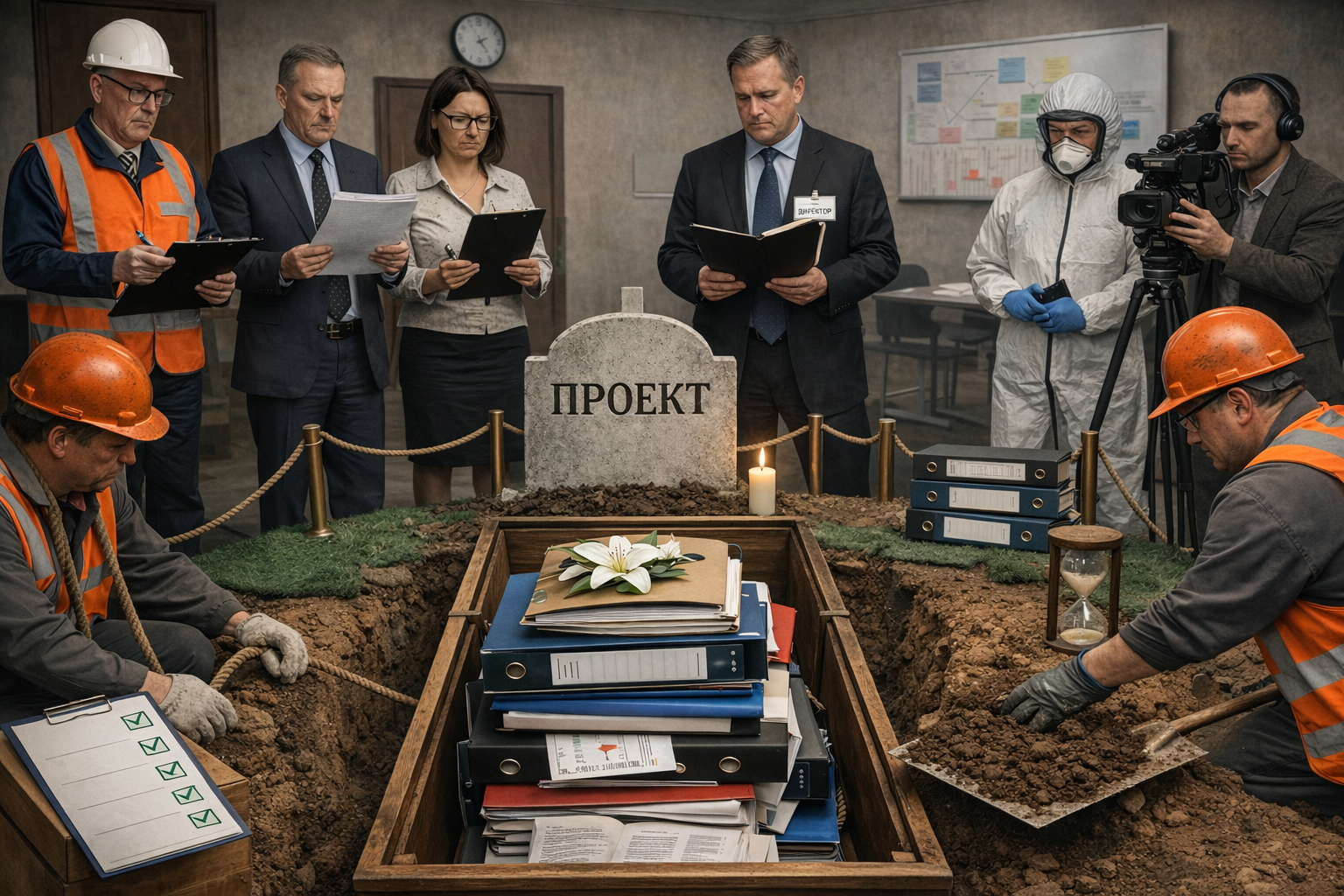
A megaproject, such as the construction of a port, power plant or oil refinery, is a huge machine with a planning horizon of years, tens of thousands of employed people and budgets in the billions. This structure has enormous inertia.
It is not easy to fail such a project: crude methods will not work - protection is activated: audit, security service, regulatory authorities.
But there is a way to be sure to fail a large-scale construction project without breaking any instructions. All actions will be seen as exemplary management, striving for efficiency and financial discipline.
Here is an algorithm of five actions that change the internal workings of the project so that in the end it devours itself.
Action #1. Total centralization
A project loses controllability when decision-making lags behind the pace of work on site.
What to do: deprive project managers and site managers of independence. Any decision, even a small one, should be tied to the head office. Create multi-level coordination contours. Reduce limits on independent purchases and reserves for unforeseen expenses.
Example: The manager must urgently receive hardware worth up to one hundred thousand rubles. The application goes through several departments and is considered for three weeks. All this time, the site is idle, and losses from downtime are hundreds of times greater than the purchase amount.
Formally, everything is correct. Discipline has been strengthened. Not a single instruction was violated.
Action No. 2. Squeezing out professionals
The success of the project depends on 15-20% of experienced engineers and specialists: chief engineers, project managers, subject matter experts. It is necessary to squeeze them out without directly firing them or disrupting the structure.
What to do: introduce distorted, unrealistic indicators of personal effectiveness. Discourage initiative and reward loyalty instead of competence.
Example: An experienced engineer finds an error in the project that requires documentation adjustments. He is deprived of his bonus for "missing deadlines" and is temporarily suspended. A "reliable manager" is appointed in his place, who regularly reports: "We are working according to plan!"
Competent specialists leave due to injustice. Those who remain are those who know how to skillfully layout reports and meet deadlines for submission. Later, defects are revealed: cracks, uneven settlement, structural failure.
Action No. 3. Supply crisis
The main thing in the project is procurement and supply: equipment, materials, services. If the supply is disrupted, the platform will stop.
What to do: approve the key procurement criterion - the minimum price. Eliminate working with reliable suppliers under the pretext of "fighting corruption" - the one who offered the lowest price wins.
Example: the tender commission chooses a cheap analogue from an unknown manufacturer instead of reliable suppliers. On paper, there are savings on the purchase lot of tens of millions of rubles. In reality - premature failure and months of waiting for repairs and spare parts. The final losses of the project exceed hundreds of millions of rubles.
Formally, everything is within the established procedures, the purchase was carried out according to regulations. The savings are justified, but the project requires the launch of a new purchase to resume production.
Action No. 4. False reporting
For management to live in their cloudless world, they need to broadcast an ideal picture right up to the point of collapse.
What to do: severely punish bad news. Creating a culture in which telling the truth about problems means signing your own career doom. Project monitoring should reflect an ideal picture: all indicators are normal, any deviations are "corrected".
Example: The site manager is aware of the disruption in the supply of materials and the delay behind schedule. But his bonus and career depend on a perfect picture in the report. He broadcasts "Let's Do It" until it becomes impossible to hide the problems.
When the truth is revealed, the situation is already irreversible, and the reasons fall out of focus: the project deadlines are missed, the work is paralyzed. Those who were responsible for project control have already received bonuses and moved to other positions.
Action No. 5. Domino effect
The final action, when all previous ones have been implemented. The project freezes at a dead point, neither back nor forward: it is impossible to stop, it is impossible to complete!
The crisis manifests itself clearly: deadlines are missed, key specialists are lost, machinery and equipment fail without the possibility of replacement, the quality of work drops to zero, the project team loses the trust of contractors and suppliers.
What to do: imitate hectic activity: hours-long meetings, corrective actions, notes, resolutions. Start a search for the culprits from the list of those who left. Immerse everyone remaining in the endless coordination of urgent and useless documents.
Bottom line. The project was buried with the wording: "Due to changes in the company's priorities" or "Due to changes in macroeconomic indicators and market conditions."
Based on the results of the audit of the project, no violations were identified: all participants in the process acted strictly according to the regulations.
Why does it work
The algorithm works on the principle of mutual responsibility - contrary to professional ethics. The project management system triggers it when control replaces results, efficiency is divorced from reality, and personal safety becomes more important than the common cause.
The text is the result of synthetic work based on materials circulating in the professional environment and does not contain recommendations for action. The examples are arbitrary, the coincidences are random.