What creates the economic effect of using schedule network modeling in managing large-scale projects


I have heard the phrase many times: "We have been planning manually in Excel for many years, everything suits us, why "reinvent the wheel" and create a schedule network model?
My article is dedicated to answering this question.
Let me start with the fact that the use of schedule network modeling (like any other project management tool) is a means, not an end. The presence of a schedule network model in itself does not create value for the project.
The economic effect and return on investment for the implementation of schedule network modeling arises from making the right management decisions based on model data.
More specifically, the schedule network model can help with the following issues:
1. Objective assessment of deadlines
The main essence of the schedule network modeling method is that schedule work deadlines are not set manually, but are calculated automatically based on the duration of the work and the logical sequence of their implementation. That is, a model approximately like this is formed:
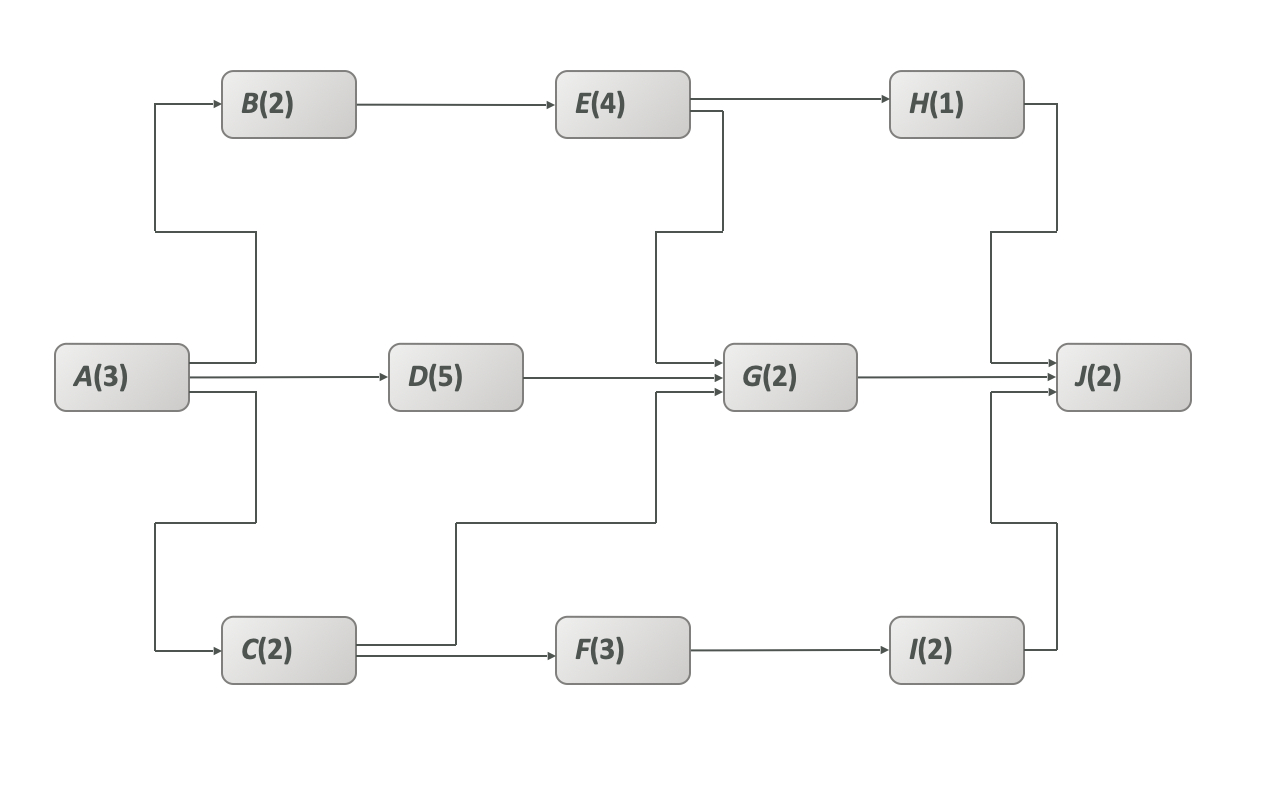
The model can take into account many factors:
- one task can have several predecessors and successors;
- different types of relationships between tasks can be established;
- it is possible to take into account seasonal restrictions for performing work;
- Different work calendars can be set for different tasks.
This model allows you to more accurately and objectively estimate the timing of the project. If in a simple and small project you may be able to accurately calculate the deadlines in Excel/manually, then in a large and complex project it is unlikely.
2. Prioritization
In the schedule network model, you can see an artifact of exceptional value: the critical path. By definition, the critical path is a sequence of activities for which the early and late start dates, as well as the early and late finish dates, coincide. I can't call this definition intuitive, so I'll explain further: in a project, as a rule, there are many parallel chains of work. Large-scale projects may have hundreds or thousands of parallel chains. The longest (longest) of all chains is the critical path of the project.
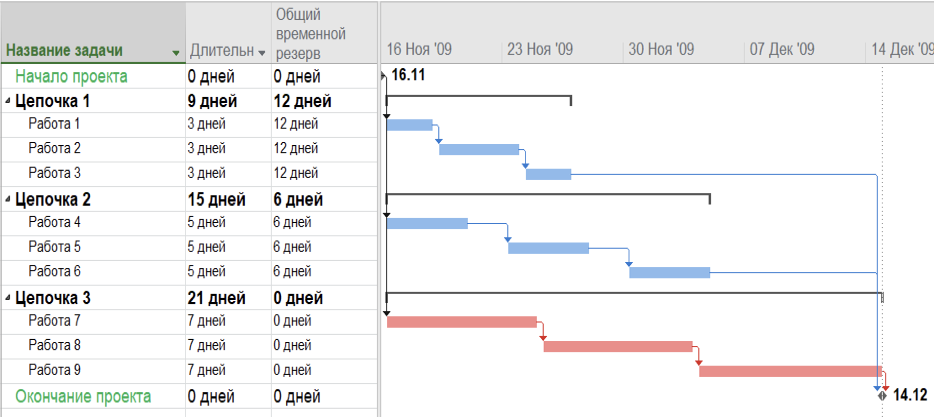
The critical path is very important to understand because:
- Only the chain of work lying on the critical path determines the overall project timeline.
- If you want to reduce the time frame for a project, you need to optimize the timing of work that lies on the critical path. Until you optimize the timing on the critical path, there is no point in optimizing anything else.
- It is the critical path activities that should be prioritized in terms of top management attention and resource allocation.
Without using schedule network modeling methods, it is hardly possible to correctly determine the critical path for a project.
3. Assessing the impact of changes
The great value of the schedule network model is that it is automatically recalculated when any changes are made to it.
In addition, for each job in the schedule network model, the total slack relative to the critical path is automatically calculated. Simply put, the total slack shows how much work can be shifted as much as possible without affecting the overall project timeline.
This, firstly, allows you to conveniently and quickly calculate different project implementation scenarios. For example, taking into account changes in the scope of work, the sequence of work, changes in the duration of work.
Secondly, when monitoring work, you can always see whether current shifts in work deadlines will affect the overall project deadlines or not. This question can be answered almost online, based on the total time reserve of the work (If the shift in the deadline for a job is less than its total reserve, there is no impact on the project deadlines. If the shift in the deadline of a job is greater than its reserve, there will be an impact on the overall project deadlines).
These functions can be very useful to you when needed:
- set deadlines for contractors/performers' work
- assess the impact of risks/changes on project timelines
- prove in the arbitration court that the deadlines were missed due to the fault of the owner
4. Comparison with original plans
As a rule, performers report on the progress of the project something like this: "Currently, we have achieved significant success - we have completed 2 key milestones, by the end of the year we plan to build on our success - we will complete 3 more key milestones":
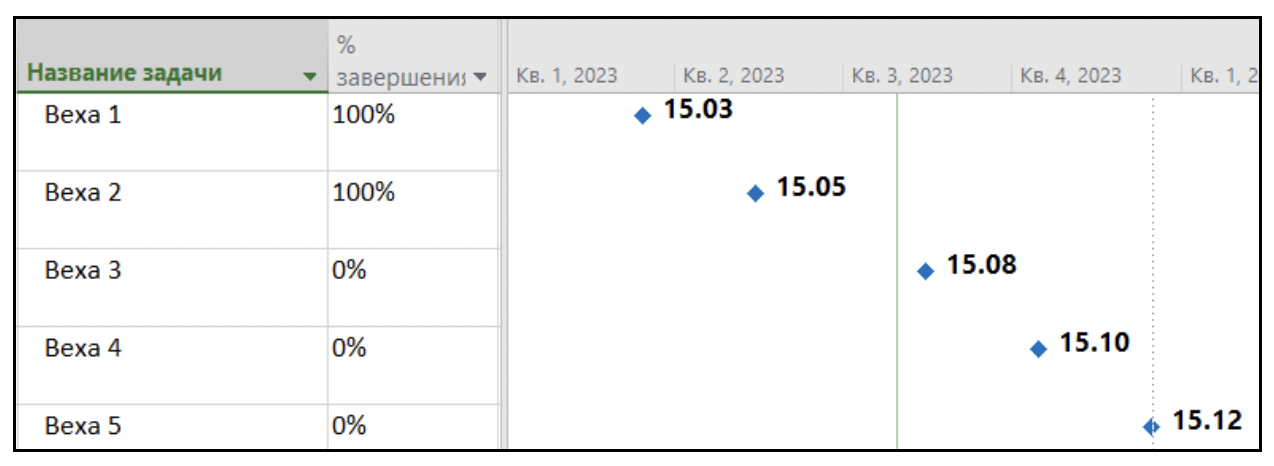
And here it cannot be said that the performer is lying. He just doesn't say anything. Because the complete picture of the project looks like this:
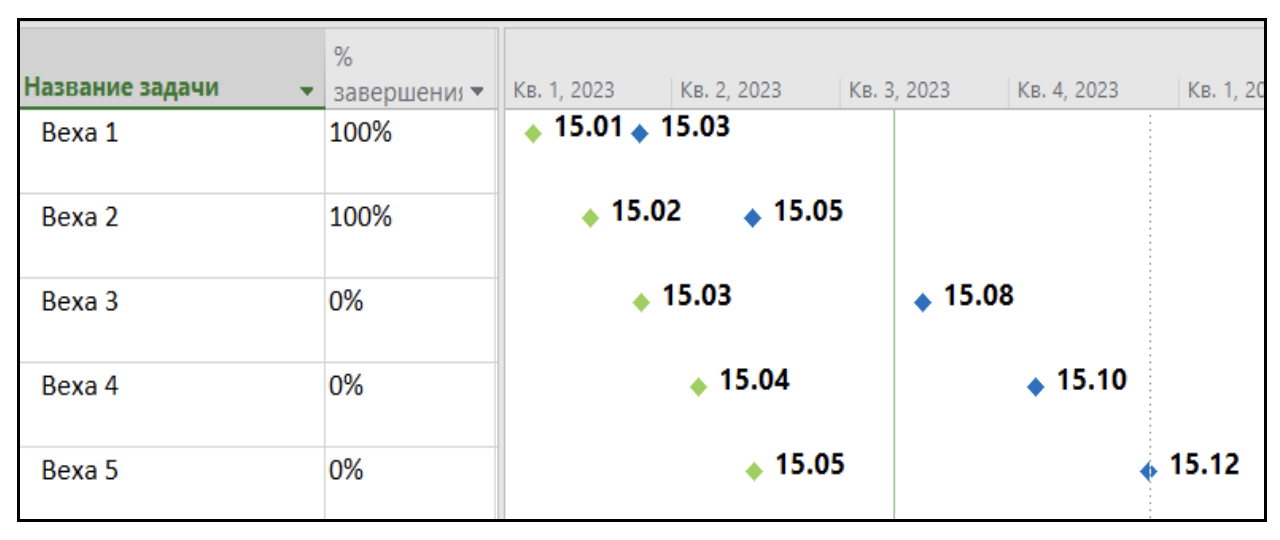
The green color in the picture shows the time frame within which the work was originally planned to be completed. In project management methodology this is called a "baseline".
That is, a more honest report would be "Currently, we have completed 2 key milestones, by the end of the year we plan to complete 3 more key milestones. At the same time, we have currently missed the deadlines for three milestones, and the overall projected project deadlines deviate by 7 months from the original plan."
Analysis of deviations from the baseline is extremely valuable information in project reporting. All programs used for schedule network modeling purposes allow you to create such reports in a beautiful form and automatically. In Excel or PowerPoint, generating such reports will require significant labor.
5. Synchronization of schedule and budget.
One of the systemic problems of managing large-scale projects in Russian practice is the lack of management integration. That is, different planning documents are not synchronized with each other and each live their own lives. This particularly applies to schedule and budget.
This is especially critical given that the criterion for the success of a project in many organizations is the implementation of the budget (I'm not saying that this is correct!). It turns out the following: at first, funds are very approximately (and often with a reserve) included in the budget for the year, then at the end of the year problems arise with the use of these funds and "it is absolutely necessary to spend the money." This money is often spent on wasteful work. According to my (rough and subjective) assessment, on a national scale, an amount of about several hundred billion rubles is "buried in the ground" annually in this way.
The opposite situation may also occur - the budget does not include funds to carry out the necessary work, which hinders the implementation of the schedule.
Schedule network modeling allows you to automatically distribute the cost of a project over time. The mechanics of the process are as follows:
- There is a schedule in which the start and end dates of work are calculated;
- There is an estimate of the cost of the work;
- When entering a cost into the schedule network model, this cost is automatically assigned to the time interval when the work is performed.
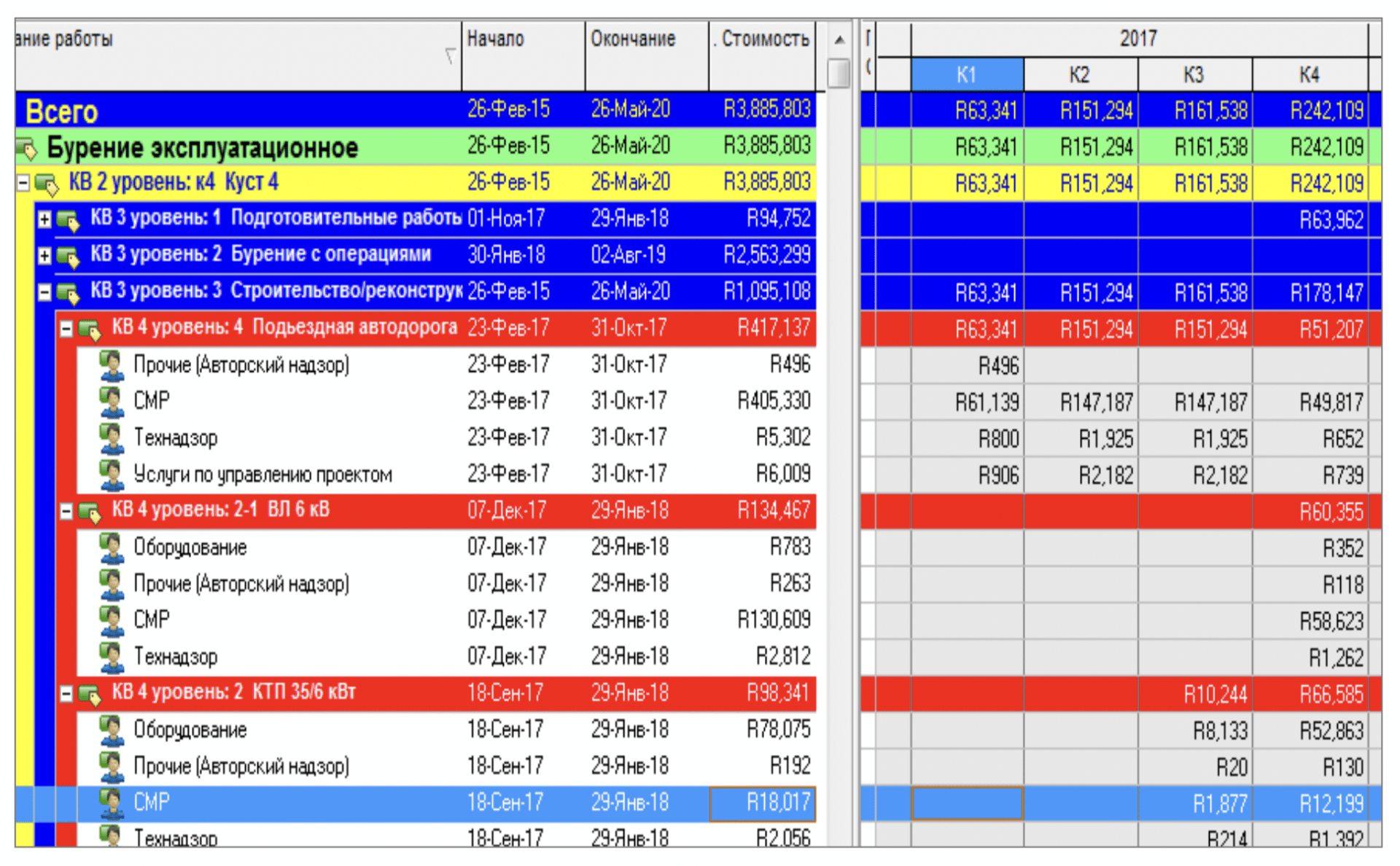
Here you can say that you can distribute the cost over time based on the schedule manually in Excel. And you will be partly right. But if it is indeed relatively easy to synchronize the schedule and budget at the beginning of the project, then maintaining this synchronization up-to-date over time, taking into account all changes in the project, as well as quickly seeing the forecast for the disbursement of funds according to the budget, taking into account current shifts in the timing of work, is extremely problematic in the absence of a schedule network model.
As mentioned above, the schedule network model is automatically recalculated when any changes are made. The same applies to the distribution of costs over time, that is, when updating the schedule network model, we can always see how a shift in work deadlines will affect the use of funds according to the budget.