
- Home
- News
- Articles
- All Articles
- Project management in construction
The construction of the first nuclear power plant in Uzbekistan may be slowed down by bureaucracy and geopolitics
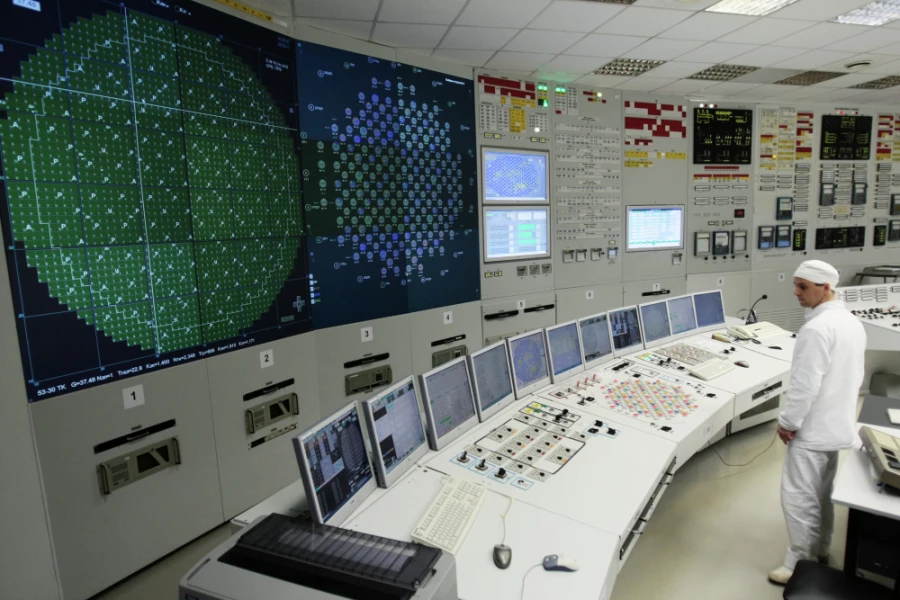
Photo: RIA Novosti
To operate such a facility, 2,000 employees are needed, said expert of the NGO "Openness and Transparency in Uzbekistan" Nodira Zikrillaeva during the Tashkent-Astana video bridge (he took place March 13), the participants of which discussed energy security and prospects for cooperation between Russia and the countries of Central Asia.
According to Zikrillaeva, if Kazakhstan, Kyrgyzstan and Uzbekistan do not help each other, the regions could find themselves in a serious energy crisis.
The first nuclear power plant in Central Asia is currently being built in Uzbekistan. As Mashnews was told by the Agency for the Development of Nuclear Energy under the Cabinet of Ministers of the Republic of Uzbekistan (Uzatom), the contract for the design, supply and construction of a low-power nuclear power plant (LNP), consisting of six power units of 55 MW each based on the Russian RITM-200N technology, was concluded on May 27, 2024. The preparatory work is currently underway.
Rosatom added that the protocol on the start of work on the low-power nuclear power plant project in the Jizzakh region of Uzbekistan was signed on September 10, 2024. This is the world's first export contract for the construction of a modern SNMM with an integral layout (the core with a steam generator are combined in a single body).
In December, the Russian JSC Scientific and Production Complex Daedalus (part of Rosatom) announced the first tender for the construction of a nuclear power plant. It concerns the construction of a fence around the future station. Contract price amounted to 400 million rubles.
Alexander Kutuzov, founder of the PM Expert company, senior vice president of PM Excellence and an expert in managing large-scale projects and megaprojects, in a conversation with Mashnews, listed the main problems that may arise during the construction of a low-power nuclear power plant in Uzbekistan, and named ways to solve them.
First in Central Asia
In fact, the nuclear power plant in the Jizzakh region is not the first in Central Asia. As Rosatom said, from 1973 to 1999, the world's first industrial fast neutron reactor BN-350 operated in the Kazakh city of Aktau. It was multi-purpose: it produced electricity, generated steam, and desalinated sea water of the Caspian Sea, near which it was built.
However, by decree of the Government of the Republic of Kazakhstan dated April 22, 1999, a decision was made to remove the BN-350 from service. There are currently no operating nuclear power plants in Central Asia.
"The NPP construction project [in the Jizzakh region] is based on the latest Russian development - the RITM-200N pressurized water reactor, the result of adapting innovative ship-based technology for land-based placement. Thermal power of RITM-200N is 190 MW, electrical power is 55 MW, service life is 60 years. The RITM-200 series reactors, on the basis of which the RITM-200N reactor was designed, were tested in the harsh conditions of the Arctic on the latest Russian icebreakers," Rosatom explained.
As the state corporation said, Uzbekistan has competence in the peaceful use of nuclear technologies. In 1959, on the basis of the Institute of Nuclear Physics, the VVR-SM research reactor was launched, developed by specialists from the Research and Design Institute of Energy Engineering named after. N.A. Dollezhal (currently part of Rosatom).
"The reactor continues to operate to this day: today, using the reactor, various radionuclides and more than 60 types of radiopharmaceuticals are produced that are exported," Rosatom said.
One reactor every six months
Rosatom is the general contractor in the project, Uzatom clarified. It is expected that the phased commissioning of power units will take place from 2029 to 2033. It is planned to launch one new unit every six months. The Uzbek side stated that the cost of the project is confidential information and is not subject to disclosure.
However, the analytical service "PM Excellence" has calculated the approximate cost. According to her, it will be $1.5-2.5 billion.
"Nuclear power plants are always expensive, and not just expensive, but very expensive: we are talking about billions of dollars. Where will this money come from, who will give it, under what conditions? The longer negotiations go on, the more the project slows down. Add here inflation, currency fluctuations and sanctions risks - and it turns out that the financial part always greatly influences the timing," Alexander Kutuzov noted in an interview with Mashnews.
Uzatom emphasized that one of the agreements between the Russian Federation and Uzbekistan provides for the attraction of local production and localization of services. "During the construction of the nuclear power plant, it is planned to attract up to 7,000 specialists from the Republic of Uzbekistan, as well as to use local raw materials, materials, semi-finished products and equipment," noted representatives of Uzatom.
Russia is a leader in nuclear energy
According to Georgy Tikhomirov, Doctor of Physical and Mathematical Sciences, Professor, Deputy Director of the Institute of Nuclear Physics and Technology of the National Research Nuclear University MEPhI, today more than 40 nuclear power units built according to Soviet or Russian designs are in operation in various countries of the world, not counting Russia. More than 30 are under construction or design. Rosatom has the world's largest portfolio of orders not only for the construction of nuclear power plants, but also for the supply of fuel and enriched uranium.
"Therefore, we can safely say that Rosatom is a reliable partner and owns all nuclear technologies at the global level. Also, one should not discount the importance of the problem of training personnel for operating nuclear power plants. Russia and Uzbekistan are united by a common past and the Russian language, which helps to establish scientific and industrial cooperation. Interaction between scientists and specialized teachers is necessary when implementing such an ambitious project as the construction of a nuclear power plant," Tikhomirov noted.
Uzatom explained that only Russia has reference experience in the construction of low-power stations. It was the first in the world to put into operation the low-power floating commercial station "Akademik Lomonosov", which supplies energy to consumers in the city of Pevek in the Chukotka Autonomous Okrug.
"As for ground-based SNMMs, today a project with integrated layout technology is presented only in Russia. Competing vendors are either just developing SNPP projects or offering scaling of projects based on high power, which affects the economic efficiency and safety of projects," Uzatom added.
How to solve problems
The most important obstacle to such construction, according to Alexander Kutuzov, is bureaucracy and licensing. The larger and more complex the project, the more approvals, examinations and regulators gather around it.
"Here Uzbekistan is building its first nuclear power plant from scratch - and immediately came across the need to create the entire regulatory framework, license the site, and form regulatory bodies. It takes several years to go through all the stages, starting with choosing a site for the station. As a result, the planned start in 2020-2021 smoothly flowed into 2024 - and only now are preparatory work beginning," the expert explained.
Kutuzov believes that to solve this problem, a simple licensing and approval scheme is needed, where there are clear deadlines and understandable stages. This is called "one window" - when you don't have to run around 20 different departments, but everything is decided centrally.
"By the way, there are already good examples - take the Emirates with the Barakah nuclear power plant. There, literally a year after the creation of the regulator, they received all the necessary permits and began construction," the expert emphasized.
In addition to bureaucracy, difficulties may arise due to financing, technical problems, logistics, geopolitics and public opinion.
"The larger the project, the more it affects the interests of different countries. For example, Uzbekistan is building a nuclear power plant with Russian help - questions immediately arise about sanctions, about long-term dependence on Russia, and there are critics of the project within the country. Many are afraid of the environment and safety - the population is worried about the water of Lake Tuzkan, which they plan to use to cool the reactors. Any protests or lawsuits from environmentalists could slow down construction for months or even years," Kutuzov said.
Therefore, broad international partnerships play an important role in the implementation of such projects. You shouldn't put all your eggs in one basket and rely on a single partner and creditor, Kutuzov explained. Uzbekistan has already taken the right path: a consortium is now being created, which includes Russia, China and some European companies. The more partners, the easier it is to manage risks, the greater the chance that if one partner drops out due to sanctions or politics, the rest will pick up the project and it will not stop.
The expert named personnel for operation as another major problem.
"The sooner we train personnel, the more engineers and managers undergo internships at existing facilities, the faster and safer construction will go. Uzbekistan has already begun work - sending students to MEPhI, arranging internships with Rosatom. Here it is important not to slow down, but, on the contrary, to strengthen preparation, so that by the time construction and commissioning begin, we already have our own, proven personnel," Kutuzov emphasized.
To speed up work, it is important to use new construction technologies. "The "open top" approach, when the reactor is installed immediately, while the station building is being built, has already made it possible to reduce construction at the Kudankulam NPP and Kursk NPP-2 by several months. We always advocate digitalization in our projects - BIM models, digital twins, information platforms that allow you to see everything that is happening right now and identify problems in advance. "Rosatom, for example, pays great attention to this," Kutuzov concluded.
MASHNEWS HELP
- Kudankulam is India's largest nuclear power plant and the flagship project of Russian-Indian technological cooperation. Rosatom provides fuel to nuclear power plants throughout their entire life cycle.
- BIM model is a copy of a building (object) in a virtual computer environment. A digital twin is a virtual model of a physical object. Uses real-time data sent from on-site sensors to model behavior and monitor operations.